

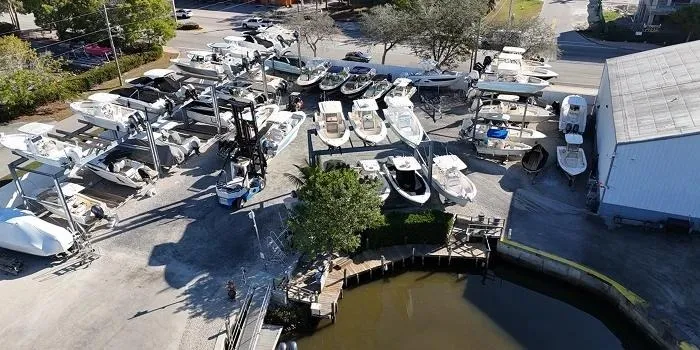
Boat storage in Naples isn’t priced the way most owners expect. The headline rate on a facility’s website is rarely what you actually pay once length-overage fees, insurance riders, electric add-ons, and auto-escalation clauses are factored in. And the cheapest lot in the search results almost always becomes the most expensive lot once you account for sun damage, theft risk, and storm exposure on a six-figure asset.
This guide breaks down what boat storage actually costs in Naples in 2026 — every tier, every fee, every variable that moves the price. We’ll show you the real range for outdoor, covered, dry-stack, and enclosed storage; the hidden fees most facilities won’t quote upfront; how vessel length, season, and location change the math; and how to read a storage contract so you don’t get blindsided by a 9% rate increase six months in. By the end, you’ll know exactly what to budget, what to negotiate, and what to walk away from.
Quick Answer
Boat storage in Naples ranges from $135 to $650+ per month depending on storage type, vessel length, and facility class. Outdoor storage runs $135 to $200, covered storage with engineered canopies runs $200 to $230, enclosed units run $250 to $450, and dry-stack marina storage runs $450 to $650+. The Hideout’s $175 to $230 covered range sits in the value-premium tier — cheaper than dry-stack, more protective than uncovered lots, and engineered to survive Florida hurricanes. Expect a 6–12% annual increase at most corporate facilities; family-owned operators typically hold rates longer.
On This Page
- The Four Storage Tiers Explained
- Full 2026 Pricing Breakdown
- How Boat Length Changes Cost
- Hidden Fees Most Owners Miss
- 5 Variables That Move the Price
- True Annual Cost of Ownership
- Where The Hideout Sits in the Market
- Why the Cheapest Option Costs the Most
- How to Read a Storage Contract
- What’s Actually Negotiable
- Frequently Asked Questions
Section 01
The Four Storage Tiers Explained
Before we get into specific numbers, it helps to understand what you’re actually paying for at each tier. Naples boat storage breaks into four distinct categories, and the price difference between them isn’t arbitrary — it reflects real differences in protection, access, and long-term value to your vessel.
Tier 1 — Outdoor uncovered storage
The cheapest tier. A fenced lot with a paved or gravel surface, marked spaces, and basic gate access. Your boat sits on its trailer under full Florida sun, salt air, and afternoon thunderstorms. Pricing reflects the minimal infrastructure: no canopy, often no electric, sometimes chain-link perimeter rather than full walls. Best suited for trailered fishing boats under 25 feet that get used weekly — vessels that don’t sit long enough to suffer significant sun and salt damage.
Tier 2 — Covered storage
The Naples sweet spot for most owners. An engineered canopy structure overhead, open sides, paved surface, and typically 30 amp electric available. The canopy eliminates direct UV exposure, deflects wind-driven rain off horizontal surfaces, and dramatically slows the aging of gel coat, decals, seals, upholstery, and tires. Top-tier facilities use canopies engineered to sustained hurricane wind ratings — a meaningful difference in a region that’s had two major storms in the past decade.
Tier 3 — Enclosed storage
A four-walled, roofed unit with a roll-up door and (usually) electric inside. Climate-controlled options exist but are uncommon in Naples for vessel-sized units — the demand isn’t there to justify the build cost. Enclosed storage suits collector boats, vessels with extensive electronics, owners who want to use the unit as a workshop, and anyone storing a boat plus significant gear. Pricing reflects the construction cost per unit and the lower density of vessels per acre.
Tier 4 — Dry-stack marina storage
A different category entirely. Dry-stack marinas store boats in racks inside a warehouse-style structure, retrieve them with a forklift, and launch them into the water on demand. You pay for the convenience of in-water access without trailering. Pricing is significantly higher than land storage, often includes a launch-and-retrieve fee schedule on top of monthly rent, and is generally limited to boats under 32 feet. This is the right answer for owners who use their boat 30+ days per year on Naples Bay or the Gulf and don’t want to deal with launching from a ramp.
Which Tier Fits Your Boat
If your boat sits more than 2 weeks at a time between uses, covered is the floor. Below that, sun and salt accelerate damage faster than the monthly savings on outdoor storage justify. If you use the boat 30+ days per year and don’t want to trailer, dry-stack is worth the premium. Everything in between is a judgment call based on the vessel’s value and how much weekend friction you’re willing to accept.
Section 02
Full 2026 Pricing Breakdown
Here is the realistic 2026 pricing range across the Naples boat storage market. These numbers reflect what owners are actually paying at facilities from East Naples to Bonita Springs — not the marketing rate, but the rate after typical add-ons.
A few patterns worth noting in this table. First, the gap between covered ($175–$230) and dry-stack ($450–$700) is large — you’re paying roughly $3,000 to $5,000 more per year for in-water convenience. Whether that’s worth it depends entirely on how often you actually launch. Second, the gap between covered and outdoor is small — usually $30 to $50 per month — while the protection difference is enormous. We’ll get to the math on that gap in Section 8. Third, enclosed pricing varies more than any other tier because unit dimensions, electric, and door height all factor in. Always ask for a quote on your specific vessel, not a published base rate.
Visual comparison — what each tier costs per year
Annual Cost Comparison
Naples Boat Storage — Average Annual Spend by Tier
$2,180
$2,580
$4,200
$6,000
$7,200
Covered storage at The Hideout costs less per year than a single weekend at most Florida resorts — and protects a six-figure asset 365 days.
Section 03
How Boat Length Changes the Cost
Length is the single biggest variable in your monthly bill, and most facilities charge by the foot once you cross a threshold. Here’s how the math typically works in Naples.
The “boat plus trailer” measurement trap
Facilities measure your total stored footprint — not the boat’s hull length. A 28-foot center console on a tandem-axle trailer with a swing-tongue often comes in at 33 to 35 feet of stored length. A 24-foot bay boat on a standard trailer measures closer to 30 feet. Always ask the facility how they measure, and always quote them the trailered length, not the hull length. Owners who quote hull length and discover they’ve signed for a too-short space sometimes face length-overage fees of $10 to $25 per foot per month.
Length pricing in covered storage at Naples facilities
$175–$195/mo
$195–$215/mo
$215–$230/mo
$230–$260/mo
Width and height matter too
Wider beam boats (over 9.5 feet) and taller t-top setups (over 9 feet of clearance needed) sometimes require oversized covered spaces with their own pricing tier. A 30-foot center console with a hardtop and tower can take a space designed for a 36-footer. Always ask about overall dimensions, not just length.
Avoid the Length-Overage Trap
- Always quote trailered length, not hull length, when getting a price
- Measure from the front of the trailer tongue to the farthest point of the boat (often a swim platform or outboard motor)
- Mention t-tops, towers, or radar arches that increase vertical clearance needs
- Ask if the facility charges overage fees for partial-foot variances, or rounds up to the next size tier
- Get the length tier confirmed in writing before move-in — verbal quotes don’t bind
Section 04
Hidden Fees Most Owners Miss
The published monthly rate is rarely what you actually pay. Here are the line items that show up on your invoice but rarely on the marketing brochure. Knowing them in advance lets you compare facilities apples-to-apples and negotiate where appropriate.
$25–$100
A one-time charge for paperwork, gate code setup, and account activation. Corporate facilities almost always charge it; family-owned operators often waive it on request.
$10–$25/mo
Some facilities require you to buy their in-house insurance rider regardless of your existing marine policy. Always ask if proof of your own coverage waives this charge — usually it does.
$15–$30/mo
Some covered storage includes electric in the base rate; many charge it separately. Marine batteries need a trickle charger between uses, so this is rarely optional — budget for it.
$10–$25/ft/mo
If your trailered length exceeds the contracted space by even a foot, some facilities charge per-foot overage monthly. This is where the “good deal” turns expensive.
$10–$25/mo
First gate code is typically free; second and third (spouse, captain, fishing partner) may be billed monthly. Watch for shared-code restrictions in the contract.
6–12%/yr
Corporate facilities routinely raise rates annually with 30 days’ notice. Over 5 years, a $200 starting rate compounds to $290–$350. Read the clause carefully.
$20–$50
Charged after a grace period of typically 5–10 days. After 60 days of nonpayment, Florida self-storage law permits lien proceedings against your vessel.
$0–$25/launch
Some dry-stack marinas include unlimited launches in the monthly rate; others charge per launch or impose a “next-day notice” requirement. This changes the real cost dramatically.
When comparing facilities, ask for an itemized quote that includes all of the above for your specific vessel. A facility quoting $175 with $40 in monthly add-ons and a 9% annual increase is more expensive in year two than a facility quoting $210 with no add-ons and a rate lock.
Section 05
5 Variables That Move the Price
Within any given tier, Naples facilities vary by $30 to $80 per month. Five factors explain almost all of that variance.
Proximity to US 41
Facilities west of Collier Blvd, close to US 41 and the water, charge $20–$40/month more than facilities east of 951. The premium reflects drive-time convenience for owners in Park Shore, Olde Naples, and Pelican Bay.
Security infrastructure
Full perimeter walls, AI cameras with license plate recognition, and 24/7 monitored access add $15–$30/month over basic chain-link and standard CCTV. Insurance carriers reward this with lower premiums.
Hurricane resilience
Facilities with documented Hurricane Irma performance and engineered canopies command a $20–$50/month premium. After Ian and Irma, this is the variable Naples owners ask about most.
Season & demand
Peak demand runs November through April with snowbird arrivals. Move-in rates are softer in summer (June–September), and some facilities offer locked-rate summer signing incentives.
Ownership model
Corporate-managed facilities apply formulaic annual increases and limit negotiation. Family-owned operators have flexibility on terms, fees, and rate locks for long-term tenants.
Section 06
True Annual Cost of Boat Storage Ownership
The monthly rent is the headline number. The true annual cost of owning a stored boat in Naples includes several other line items that owners regularly underestimate. Here’s the realistic budget for a mid-size center console (28–32 ft) at a quality covered storage facility.
Storage itself accounts for $2,520 to $2,760 of that total — roughly 30 to 40 percent of all-in annual ownership cost. The variable that swings the budget hardest isn’t storage; it’s insurance and maintenance. Both of those line items respond directly to where the boat is stored. Covered, secured storage typically reduces insurance premiums by 5–15% and maintenance costs by 20–30% over uncovered storage because the boat ages slower.
The Hidden ROI of Better Storage
Upgrading from uncovered ($175/mo) to covered ($210/mo) costs $420 extra per year. Typical savings: $200–$400 on insurance, $300–$900 on annual maintenance, plus 10–20% higher resale value on a sun-protected hull. Net: covered storage pays for itself within the first 18 months of ownership.
Section 07
Where The Hideout Sits in the Naples Market
The Hideout Storage Park has been operating under the Basik family in Southwest Florida since 1972, and we were named Toy Storage Nation Facility of the Month in March 2026. We’re the largest vehicular storage facility in Florida and the only Naples facility with a documented zero-damage record through Hurricane Irma. Here’s exactly where our pricing sits relative to the market:
Hideout boat storage pricing — 2026
Outdoor storage from $175/month — full perimeter walls, AI security cameras, paved surface, 24/7 gate code access. No chain-link, no shared codes.
Covered storage from $200–$230/month — Baja-engineered canopies built to sustained Florida hurricane wind ratings, 30 amp electric available, same perimeter and surveillance.
Phase II Elite Storage Condos — 25×55 ft units with mezzanine, private bathroom, and custom cabinetry. Ownership, not rent. Designed for collectors and multi-vessel owners who want to convert recurring storage expense into a real-estate asset.
No administrative move-in fee on standard contracts. No surprise rate-escalation clauses. No required in-house insurance products if you carry your own marine coverage.
Heather, our office manager, who quotes your exact vessel and trailered length on the spot — not a base rate that changes when you arrive.
Hideout vs. typical Naples market
Covered Storage Comparison
5-Year Total Cost — 32 ft Center Console
$12,900
$15,800
$35,400
Over 5 years, The Hideout’s held-rate model saves $2,900 vs. a typical corporate facility and $22,500 vs. dry-stack — while delivering the same hurricane-engineered protection.
“I priced four facilities. Two had hidden fees that put them above The Hideout’s covered rate. The other two had chain-link fencing. This wasn’t a hard decision.
— Paraphrased from recurring owner feedback
Section 08
Why the Cheapest Option Often Costs the Most
Search “cheap boat storage Naples” and you’ll find lots quoting $130 to $150 per month. The math looks compelling — $400 to $600 a year less than covered storage. Here’s what those facilities usually don’t tell you, and why the savings rarely survive the first 24 months.
UV exposure compounds fast in Naples
Naples averages 266 sunny days per year with a UV index regularly above 11 from April through September. A boat parked uncovered for 18 months typically shows visible gel coat oxidation, decal lift, hardened rubber seals, and faded upholstery. Professional gel coat restoration on a mid-size center console runs $2,000 to $5,000. Replacing oxidized decals adds $500 to $1,500. Reseal work on cracked rubber adds another $300 to $800.
Salt air kills electronics and metals
Even four miles inland from Naples Bay, salt-laden coastal air corrodes exposed metal at 2–3x the rate of dry inland climates. Battery terminals, electrical connectors, brake components on trailers, railings, hinges, and engine compartments all degrade faster. Trailer brake replacement alone can run $400–$800 on a tandem-axle setup. Marine electronics corrosion is the hidden killer — a faulty connector can take out a $3,000 GPS unit.
Tire degradation accelerates
Uncovered trailer tires in Naples sun age roughly twice as fast as in cooler climates. Tires rated for 5 years of service typically need replacement after 3. A set of four trailer tires runs $400–$800 depending on size. More importantly, a blown tire on a fully loaded boat trailer on I-75 isn’t an expense — it’s a safety event that can total your trailer and damage the hull.
Resale takes a 10–20% hit
When you sell a boat that’s been stored uncovered for several years in Naples, buyers and brokers see the sun damage immediately. A 2020 32-foot center console with faded gel coat and replaced decals trades for $15,000 to $30,000 less than the same boat with crisp original finish. The two-year savings on uncovered storage ($720 to $1,200) become a five-figure loss at resale.
The Real Cost Math on “Cheap” Storage
$30/month savings on uncovered storage = $360/year saved.
Typical 3-year cost of uncovered exposure on a 32 ft center console: gel coat restoration ($3,000) + decals ($800) + seals ($500) + premature tire replacement ($600) + dead battery cycle ($400) + 12% resale value loss ($18,000+) = $23,000+ in damage and lost value. Three years of “savings” total $1,080. Net loss: roughly $22,000.
Section 09
How to Read a Naples Storage Contract
Storage contracts in Florida are governed by Chapter 83, Part IV of the Florida Statutes — the Self-Service Storage Facility Act. Most contracts are 4–8 pages and most owners skim them. Here are the six clauses that actually matter for your wallet and your vessel.
Look for language like “Owner reserves the right to adjust rates with 30 days’ written notice.” This is where 9%/year compounding starts. Negotiate for a 12-month rate lock at minimum, or a capped annual increase tied to CPI.
Florida self-storage law permits lien proceedings after as little as 60 days of nonpayment. Some contracts shorten the cure period or expand what the lien covers. Read carefully if you travel for months at a time.
Many contracts require either proof of your marine policy or purchase of the facility’s product. Some require both. Always ask what the facility insurance actually covers — many policies cover only fire, not theft or storm damage.
Most contracts auto-renew month-to-month. A few require 30 to 60 days’ notice to cancel. If you sell the boat mid-contract, this matters — you may owe a partial-month or move-out fee.
Some facilities require you to remove your vessel during named-storm warnings; others manage shelter-in-place protocols. This is a major operational and insurance difference. Ask before signing.
Every storage contract limits the facility’s liability for damage. The cap is typically $2,000 to $5,000. Your marine policy is the real protection — never rely on the facility’s liability coverage for a six-figure vessel.
Section 10
What’s Actually Negotiable
Storage pricing isn’t entirely fixed — especially at family-owned facilities. Here’s what’s reasonably negotiable in Naples, and how to ask for it.
Almost always negotiable on direct ask, especially with a 12-month commitment. Savings: $25–$100 one-time.
Often available at family-owned operators with a 12-month prepay or auto-pay commitment. Savings over 5 years: $1,500–$3,000 vs. compounding annual increases.
Pay 12 months upfront, get one month free. Some facilities offer this only on request. Savings: roughly 8.3% on the year.
If you have your own marine policy, ask to opt out of the facility’s insurance product. Most legitimate facilities will accept proof of coverage. Savings: $120–$300/year.
Storing a boat plus an RV, plus a work trailer? Ask for a portfolio rate. Typical multi-unit discount runs 5–10% off list pricing per unit.
June through September is the soft season in Naples. Facilities sometimes offer first month free or locked-rate signing bonuses to fill space before snowbirds arrive. Always ask in summer.
Stop Comparing Brochure Rates. Get Your Vessel Quoted.
Heather quotes your exact vessel and trailered length on the spot — no add-on surprises, no escalation clauses, no fine print games.
Or call directly — covered, outdoor, and Elite Storage Condo options available
FAQ
Frequently Asked Questions
What is the average cost of boat storage in Naples, FL?
For a typical 28 to 32 foot center console, outdoor storage averages $175 per month and covered storage averages $210 per month. Enclosed units run $250 to $450, and dry-stack marina storage runs $450 to $700+. The Hideout’s covered storage starts at $200 per month, which sits in the value-premium tier of the Naples market.
Is covered boat storage worth the extra cost over outdoor?
In Naples, yes — for almost every owner. The $30 to $50 monthly premium for covered storage is roughly $360 to $600 per year. Typical savings on insurance, maintenance, and preserved resale value run $2,000 to $5,000 per year on a mid-size boat. Covered storage typically pays for itself within 18 months of ownership.
How much does dry-stack boat storage cost in Naples?
Dry-stack marina storage in Naples runs $450 to $700+ per month depending on vessel length, plus possible per-launch fees. A 28-foot boat typically runs $450 to $550 monthly; a 35-foot boat runs $600 to $700+. Annual cost of dry-stack often exceeds $6,000, making it 2 to 3x more expensive than land-based covered storage.
Do storage facilities charge by hull length or trailered length?
Most Naples facilities charge by total stored footprint, which means trailered length — the front of the trailer tongue to the farthest point of the boat (usually the outboard motor or swim platform). A 28-foot center console often measures 33 to 35 feet when trailered. Always quote the trailered length, not the hull length, to avoid overage fees.
Are boat storage rates negotiable in Naples?
At family-owned facilities like The Hideout, yes — particularly on move-in fees, rate locks, and multi-vehicle bundling. Corporate facilities have less flexibility. Ask about prepaid annual discounts, waived administrative fees, summer move-in incentives, and rate-lock options before signing.
How much do annual rate increases add to boat storage cost?
Corporate facilities in Naples typically raise rates 6 to 12 percent annually. A $200 starting rate compounds to roughly $290 to $350 over 5 years. Family-owned operators often hold rates longer or offer rate locks for long-term tenants. Always ask about the historical rate-increase pattern before signing.
Do I need to buy the facility’s insurance product if I have my own?
Usually no — most facilities accept proof of your existing marine policy in lieu of their in-house insurance product. This typically saves $120 to $300 per year. If a facility refuses to waive the rider despite proof of your own coverage, that’s a signal to evaluate their other terms carefully too.
What’s the cheapest boat storage option in Naples?
Outdoor uncovered storage at smaller, east-of-951 facilities runs $135 to $165 per month for vessels under 25 feet. We rarely recommend the cheapest tier — the savings of $40 to $60 per month are usually overwhelmed by sun damage, faster maintenance cycles, and 10 to 20 percent resale value loss over 3 years. Covered storage delivers far better total-cost economics.
Does electric service cost extra for boat storage?
It depends on the facility. Some Naples operators include 30 amp electric in covered storage rates; others bill it as a $15 to $30 monthly add-on. Trickle-charging your battery between uses is essentially required — marine batteries die in 8 to 12 weeks without it. Budget for electric one way or the other.
Is it cheaper to buy a storage condo or rent boat storage long-term?
For owners with multiple vessels, long-term Naples plans, or collector-grade assets, buying an Elite Storage Condo at The Hideout often makes more financial sense than 10 to 20 years of rent payments. The math depends on the unit price, your time horizon, and whether you want the unit to double as a workshop. Single-vessel owners with shorter horizons usually do better with monthly rent.
When is the best time of year to sign a Naples storage contract?
Summer — June through September. Demand softens after snowbirds head north and before hurricane season peaks, and facilities sometimes offer locked-rate signing incentives or first-month-free promotions to fill space. By contrast, November through April is peak demand and worst negotiating leverage.
Does covered storage reduce my boat insurance premium?
Usually yes — by roughly 5 to 15 percent for marine policies, depending on the carrier. Storing at a secured, gated facility with engineered canopies and documented hurricane resilience reduces exposure to theft, vandalism, vehicle strike, and storm damage. Some Florida carriers now charge surcharges for boats stored at home in coastal counties.
The Bottom Line
For Naples Boat Owners
Boat storage in Naples isn’t really a $135-versus-$230 decision. It’s a decision about what happens to your hull, your decals, your seals, your tires, your electronics, and your resale value over the next 5 to 10 years. The $30 to $50 monthly difference between uncovered and covered storage compounds into thousands of dollars in preserved value over a typical ownership cycle — and the gap between a hurricane-engineered facility and a chain-link lot can be the difference between a clean insurance claim and a totaled vessel after the next named storm.
The Naples boat owners who get this right treat storage as an asset-protection decision, not a budget line. They read the contract before they sign, ask for the rate-lock, opt out of unnecessary insurance riders, and choose facilities with infrastructure that justifies the premium. Total annual cost of boat ownership in Naples runs $6,000 to $9,000 for a mid-size vessel — storage is roughly a third of that, and it’s the line item with the largest indirect impact on every other line.
If you want a quote on your exact vessel with all fees disclosed upfront, Heather and the team at The Hideout can walk you through covered, outdoor, and Elite Storage Condo options in under five minutes. Reserve a space at The Hideout and stop comparing brochure rates that don’t tell the whole story.
