

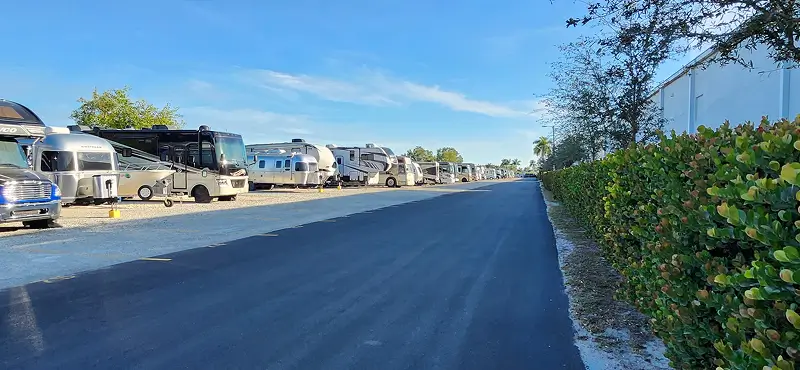
Storage in Southwest Florida isn’t like storage anywhere else. The combination of subtropical humidity, year-round UV, salt-laden coastal air, summer thunderstorms, and a six-month hurricane window means an RV left sitting without preparation can lose thousands of dollars in seal life, battery health, tire integrity, and interior condition in a single off-season. The good news is that everything that goes wrong in Naples storage is preventable, and most of it is preventable in an afternoon.
This guide is the complete checklist we walk Naples RV owners through before they store their Class A, Class C, fifth-wheel, or travel trailer for the summer, the hurricane season, or a snowbird departure back north. It covers exterior prep, fluids and engine, batteries and electrical, plumbing and tanks, interior protection, tires and chassis, pest prevention, and what to look for in a facility that actually protects your investment instead of just parking it.
Quick Answer
To prepare an RV for long-term storage in Southwest Florida, complete eight key steps: wash and wax the exterior; treat all rubber seals; fill the fuel tank with stabilizer; change the oil and filter; disconnect or trickle-charge the batteries; drain and sanitize the fresh water system; clean and dehumidify the interior; and inflate tires to spec on covered or shaded ground. The whole process takes 3 to 5 hours and prevents thousands of dollars in damage from UV, humidity, salt air, and pests. Covered storage with 30 amp electric makes most of these steps easier and protects the rest of your work.
On This Page
Section 01
When to Start Storage Prep
Timing matters more in Southwest Florida than almost anywhere else. The wrong week can mean the difference between a smooth storage season and a dead-battery, mildew-on-the-headliner, dry-rotted-tire return.
For snowbirds heading north (April–May)
Most Naples snowbirds leave between mid-April and early May. By the time you’re packing the car, the daily heat index is already pushing 95°F and afternoon thunderstorms are starting. Plan to complete RV storage prep at least 5–7 days before departure so you have time for a final inspection, any last-minute parts orders, and a battery-tender test run. Booking covered storage with 30 amp electric should happen in February or March — by April, most Naples facilities with engineered canopies are full.
For hurricane-season storage (May–November)
Atlantic hurricane season officially runs June 1 through November 30. Naples sits in one of the most active hurricane corridors in the country. If you’re storing an RV through the season, complete prep no later than mid-May. Covered storage with full perimeter walls and engineered canopies — like Baja-engineered structures that came through Hurricane Irma intact — is the standard for hurricane-season RV storage in Collier County.
For short-term storage between trips (any season)
If the RV will sit for 30 to 60 days between trips, you can skip the deeper steps (oil change, full tank drain) but you still need to address batteries, tires, seals, and interior humidity. Naples doesn’t have a “low-stress” storage season — even a 30-day sit in July without a battery tender will leave you with dead house batteries and mildew in the bunks.
Section 02
Exterior Preparation
Salt air, UV, and afternoon rain hammer an RV’s exterior every day in Naples. The work you do before storage determines whether your finish, decals, and seals make it through the season — or whether you’re booking detail and seal-replacement appointments in October.
Wash, decontaminate, wax
Start with a thorough wash using an RV-specific soap. Naples coastal residue includes salt, pollen, road tar, and the iron particles that come from working brakes and trailer hubs. After washing, decontaminate with a clay bar to lift embedded particles, then apply a high-quality carnauba or synthetic wax. This single step extends paint life by years and is the cheapest insurance you’ll buy for the season.
Treat every rubber seal and gasket
This is the step most owners skip and most regret. UV and heat dry out the rubber seals around windows, slide-outs, roof seams, door frames, and storage bays. Once they crack, water finds its way in — and in Naples, that means mildew, soft floors, and ceiling stains. Use a quality rubber protectant (303 Aerospace, Thetford Premium, or equivalent) on every visible seal, and inspect the roof seams closely. Reseal any compromised area with manufacturer-spec sealant before storage, not after.
Inspect and reseal the roof
Roof seams, vent gaskets, AC shrouds, and antenna bases all expand and contract with Naples heat cycles. Walk the roof (carefully — check your manufacturer’s load rating first) and look for hairline cracks, lifting Dicor, and any spot where sealant has yellowed or pulled away from the surface. A $20 tube of self-leveling lap sealant applied now saves a $4,000 ceiling repair in October.
Cover or stow exterior accessories
Remove anything you don’t need exposed: bike racks, grills, hose reels, outdoor mats, leveling blocks left under the wheels. If you’re storing outdoors, consider a quality breathable cover; if you’re storing under engineered covered canopies, you may not need one — the canopy does the work and a cover can actually trap humidity against the surface in Naples conditions.
Section 03
Fluids and Engine
Stored fuel, oil, and coolant all degrade differently in Florida heat. Get these right and the RV starts the first time when you’re ready to use it again. Get them wrong and you’re looking at injector cleanings, gummed-up carburetors (on generators), and acidic oil eating bearings.
Fill the fuel tank and add stabilizer
Fill the tank completely before storage. A full tank leaves no room for condensation, which is the primary cause of water in stored fuel. Add a quality fuel stabilizer (Sta-Bil, Star Tron, or Sea Foam) at the manufacturer’s recommended ratio, then drive 15–20 minutes to circulate the treated fuel through the entire system. For diesel pushers, use a diesel-specific biocide and stabilizer.
Change the oil and filter
Used oil contains combustion acids that become aggressively corrosive when the engine sits. If you’re storing for 60+ days, change the oil and filter before parking — not after. Same for the generator: run it under load for 20–30 minutes, then change its oil and filter on the same schedule. Generators in Naples humidity that go a season without service tend to develop carb varnish and starting issues.
Top off coolant and check the radiator
Verify coolant strength and top off if needed. In Naples, you don’t need freeze protection, but you do need the corrosion inhibitors fresh coolant provides. While you’re there, inspect the radiator and condenser fins for road debris, palmetto bug carcasses, and salt buildup — all of which are routine in Southwest Florida and reduce cooling capacity over time.
Address the LP system
Close the LP tank valve. Most owners leave it open for the fridge in transit; for storage, close it. This eliminates the slow regulator leak path and protects the LP appliances from running dry. If your RV will sit unattended in covered storage with 30 amp electric, switch the fridge to electric or shut it off entirely after a thorough cleaning.
Section 04
Batteries and Electrical
Batteries are the single most common failure point for stored RVs in Naples. The combination of heat and humidity accelerates self-discharge, sulfation, and corrosion at the terminals. The math is straightforward: a lead-acid house battery left disconnected in Naples summer heat will discharge in 8 to 12 weeks. AGM batteries last a little longer; lithium iron phosphate (LiFePO4) handles storage better but still benefits from a maintainer.
The 30 amp electric solution
If your storage facility provides 30 amp electric hookups in covered spaces, the entire battery problem is solved. Plug in your shore power cord, set your converter to maintain mode (or use a dedicated battery tender on each battery bank), and walk away. The batteries stay topped off, the onboard electronics keep their settings, and you can run a small dehumidifier inside the cabin while you’re away. This is the single biggest argument for choosing a facility with electric over one without.
If no electric is available
Disconnect both the chassis and house battery banks. Use the battery disconnect switches if your RV has them; if not, remove the negative cables. Clean the terminals with a baking soda paste, dry them, and apply a thin coat of dielectric grease or terminal protectant. If storage is over 60 days, remove the batteries entirely and store them on a wood surface (not concrete) in a climate-controlled space with a smart maintainer connected. Replacement of a single failed house battery in a Class A motorhome runs $300 to $600; a full bank can exceed $1,500.
Shut down parasitic loads
Even with batteries disconnected, modern RVs have parasitic draws: propane leak detectors, CO detectors, refrigerator boards, slide-out controllers, inverter standby modes. The disconnect switch handles most of them, but verify by checking each switch panel before you walk away. For lithium systems, follow your manufacturer’s storage protocol — some require partial state-of-charge (around 50%) for long-term storage, not full charge.
Section 05
Plumbing and Tanks
In a cold climate, RV plumbing winterization means antifreeze. In Naples, you don’t need freeze protection — but you absolutely need to address stagnant water, which becomes a bacterial and odor problem fast in 75% humidity and 90°F+ ambient temperatures.
Drain and sanitize the fresh water system
Drain the fresh water tank completely. Open all faucets (hot and cold), the outside shower, and the low-point drains. Bypass the water heater and drain it via the anode rod or drain plug. Once fully drained, sanitize the system with a bleach solution (1/4 cup per 15 gallons of tank capacity), run it through every fixture until you smell chlorine, let it sit for 12 hours, then flush thoroughly with fresh water. Drain again completely. The RV returns to service in October with a clean, odor-free water system.
Empty and treat the holding tanks
Dump the gray and black tanks at a proper dump station, then rinse each tank with a built-in flush system or a wand. Add a holding tank treatment formulated for storage (Happy Camper, Aqua-Kem Storage, or similar) with about a gallon of water to keep seals lubricated and prevent dry-out. Leave the valves closed for storage. Florida heat dries out tank seals quickly, and seal replacement requires pulling the tank — a $500 to $1,200 service.
Address the water heater and ice maker
Drain the water heater fully. If you have a residential-style refrigerator with an ice maker and water dispenser, run a sanitizing cycle through the lines, then disconnect the water supply. Empty the ice bin, clean and dry the dispenser tray, and prop the refrigerator door open with the manufacturer’s storage clip to prevent mildew on the interior gaskets.
Section 06
Interior Protection
A sealed RV in Naples humidity is a mildew petri dish if you don’t prepare the interior. The goal is to remove every source of moisture and food, then reduce ambient humidity to a level that won’t support mold growth.
Empty the Fridge and Pantry
Remove every food item, even sealed packages. Pantry moths and pantry beetles are aggressive in Naples and they don’t care if the rice is in original packaging. Clean shelves with mild bleach solution.
Deep Clean Surfaces
Vacuum carpets, wipe down counters and cabinets, clean the bathroom thoroughly. Any organic residue becomes mildew food. Pay special attention to the slide-out tracks and rubber gaskets.
Drop Humidity
Place DampRid containers in the cabin (2–4 large containers for a Class A). With 30 amp electric, run a small dehumidifier set to 50% RH. Without electric, increase DampRid coverage and check it on every visit.
Block UV at Windows
Close all blinds and shades. If stored outdoors or in partial sun, add reflective windshield shades. UV fades upholstery, dashboards, and flooring in months in Southwest Florida.
Open Cabinets and Drawers
Crack cabinet doors and drawer fronts to allow air circulation. Closed enclosed spaces in humid storage develop mildew on the inside surfaces even when the cabin air is dry.
Remove Anything Valuable
Electronics, jewelry, important documents, prescriptions, and firearms go home with you — even at a secured facility. The Hideout has AI cameras and license plate readers, but valuables don’t belong in long-term storage anywhere.
Section 07
Tires, Chassis, and Slides
Tires are the second-biggest storage casualty after batteries. UV, heat, ozone, and uneven weight loading destroy sidewalls faster than most owners expect — especially in Naples.
Inflate to maximum cold pressure
Check each tire’s maximum cold pressure rating on the sidewall and inflate to that figure. Storage flat spots and sidewall flex from underinflation accelerate cracking. If you’re storing for 90+ days, consider tire cradles or leveling blocks under each tire to reduce contact pressure and distribute load.
Cover or shade the tires
Direct sun is the enemy. UV destroys sidewall compounds and ages tires roughly twice as fast in Naples as in cooler dry climates. Use tire covers if storing outdoors. If you’re under covered RV storage with proper canopy clearance, the canopy handles it. Industry rule of thumb: a 5-year tire stored uncovered in Naples is closer to a 3-year tire.
Lubricate the chassis and slides
Grease every accessible chassis fitting per your manufacturer’s schedule. Lubricate slide-out mechanisms with the manufacturer-recommended product (typically a dry silicone for the rails and a lithium-based grease for the gears). Operate each slide all the way in and out once after lubrication, then store with all slides retracted to minimize seal exposure to weather and pests.
Engage the parking brake correctly
For long-term storage, chock the wheels and leave the parking brake released — engaged parking brakes can seize or rust to drums in humid storage. For shorter sits, engaging is fine. Always chock both directions on any incline.
Section 08
Pest Prevention
Naples is rough on stored vehicles for one reason most northern owners don’t expect: bugs and rodents. Palmetto bugs (large flying cockroaches), tree frogs, geckos, ants, wasps, and roof rats all see a parked RV as ideal habitat. Prevention is far easier than remediation.
Section 09
Choosing the Right Storage Facility
Even a perfectly prepared RV can be undone by the wrong storage facility. In Southwest Florida, four facility features make the biggest difference for stored RVs:
The Hideout offers all four in outdoor RV storage tiers and full-feature covered storage with Baja-engineered canopies. We came through Hurricane Irma in 2017 with zero damage to stored vehicles — the kind of track record that matters more than any marketing claim when you’re storing a $200,000 motorhome through hurricane season.
Authority Source
The RV Industry Association publishes general storage recommendations, but their guidance is written for a national audience. In Southwest Florida, the humidity, UV, and hurricane factors require more aggressive protection than the standard checklist accounts for — particularly around battery maintenance, seal treatment, and roof inspection.
Section 10
Common Storage Mistakes
The most expensive mistakes Naples RV owners make — and the realistic dollar cost of each:
Dead batteries on return are the #1 storage complaint in Naples. House battery banks for Class A motorhomes run $800–$1,800 to replace; chassis batteries add $200–$400 more.
Even sealed packages attract pantry moths, ants, and roof rats. Pest remediation in an RV can run $500–$2,000 plus the cost of any chewed wiring or insulation.
Condensation forms in the empty volume. Water in fuel causes injector issues, fuel pump failures, and on diesels, microbial contamination. Fuel polishing and filter replacement run $300–$800.
A $20 tube of sealant prevents $4,000+ ceiling and structural repair. Naples thunderstorms find every crack within a season.
UV, salt air, and storm exposure compound over a single summer. Resale on a sun-faded RV drops 10–20%. The annual difference between covered and uncovered storage in Naples is roughly $360 — vs. thousands in cumulative damage.
A monthly 15-minute visit — refresh DampRid, check for pests, verify the maintainer is working — catches problems while they’re still cheap. Skipping it is how a $50 leak becomes a $5,000 repair.
Store Your RV Where It’s Actually Protected
Covered RV storage with 30 amp electric, Baja-engineered canopies, and 24/7 access — 10 to 15 minutes from most Naples communities. Heather can walk you through availability today.
Covered tiers fill by April — reserve in February or March
FAQ
Frequently Asked Questions
How long does it take to prepare an RV for long-term storage in Florida?
A thorough storage prep on a Class A or large fifth-wheel takes 3 to 5 hours of hands-on work, plus a 15–20 minute drive to circulate stabilized fuel. Smaller travel trailers and Class B vans can be done in 2 to 3 hours. Block out an afternoon and complete it at least 5–7 days before you depart.
Do I need to winterize my RV in Naples, Florida?
You don’t need antifreeze in the plumbing — Naples temperatures don’t threaten freeze damage. But you do need to drain the fresh water system, sanitize it, and address humidity-related risks. Florida storage prep is its own discipline — closer to “summerization” than winterization.
Should I disconnect my RV batteries or use a tender?
A tender is always better when 30 amp electric is available. Disconnected lead-acid batteries in Naples summer heat discharge in 8–12 weeks and sulfate quickly. With a maintainer, batteries last their full design life and the RV is ready to use the moment you return.
How often should I visit my RV during long-term storage?
Once a month is the right rhythm. A 15-minute visit lets you refresh DampRid, check for pest activity, verify the battery maintainer is functioning, walk the roof seams, and run the engine briefly if appropriate. Most problems caught at a monthly visit cost under $100 to fix; problems found six months later cost thousands.
Is covered RV storage really worth it in Southwest Florida?
Yes, almost always. The extra $30/month vs. outdoor storage typically returns several multiples in preserved paint, decals, seals, tires, and battery life. On resale, a covered-stored RV brings 10–20% more than a sun-faded equivalent. In hurricane season, covered storage with engineered canopies adds protection no cover can provide.
Should I leave my RV slides in or out during storage?
In. Always retract slides for long-term storage. Extended slides expose seals to UV, weather, and pests, and the deployed position keeps the seals compressed in a way they’re not designed for over months. Retracted, the seals stay protected and the RV occupies its narrowest footprint.
How do I keep pests out of my RV in Florida storage?
Three layers: seal external openings with steel wool, place bait stations under the chassis, and use peppermint or Fresh Cab repellent pouches inside cabinets every few feet. Refresh the interior repellents every 30 days. A storage facility with full perimeter walls and active pest management dramatically reduces the load you have to fight on your own.
When should I book my Naples RV storage spot?
For covered storage with engineered canopies and 30 amp electric, reserve in February or March. By April, most premium Naples facilities are full for the season. Outdoor uncovered spots are easier to find on shorter notice, but the best covered locations — particularly those that came through Hurricane Irma intact — get spoken for early every year.
The Bottom Line
For Naples RV Owners
Southwest Florida punishes stored RVs harder than almost any other climate in the country. The good news: a thorough afternoon of prep, combined with the right facility, makes the off-season a non-event. The bad news: skipping any step in this checklist is usually a four-figure mistake by the time you return.
If you want the easier version, store at a facility that does the heavy lifting for you — covered canopies that block UV and rain, 30 amp electric that keeps your batteries alive, full perimeter walls that block pests and weather, and a team that’s been doing this in Naples since 1972. Reserve a space at The Hideout and start the season knowing your RV is actually protected.
