

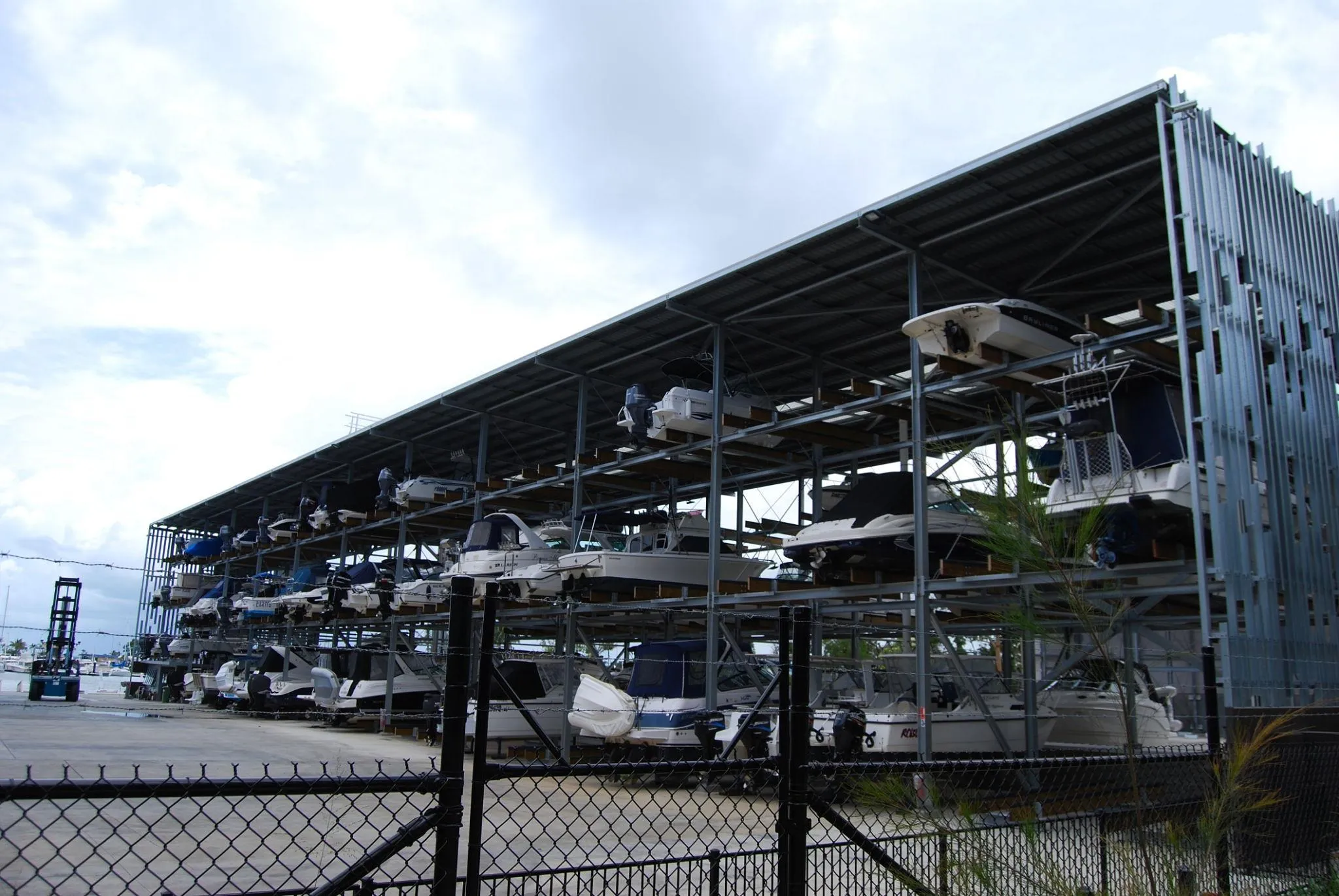
Nearly every ramp queue is caused by the same thing: people doing in the launch lane what belongs in the staging lot. Load gear, fit the drain plug, remove tie-downs, disconnect lights and brief your crew before you back down. Do that and you are off the ramp in two minutes. Arriving with the boat already prepped is one of the quiet advantages of storing it on a trailer nearby.
In season, the ramps around Naples and Marco Island get genuinely busy, and the difference between a pleasant morning and a bad one is almost never the number of boats. It is how many of them treat the ramp as a preparation area.
This is the short version of how not to be that boat.
What is the single most important rule of boat ramp etiquette?
Do all your preparation in the staging area before you get in the launch line. Gear loaded, cooler aboard, drain plug in, straps and tie-downs off, trailer lights unplugged, crew briefed on who does what. The launch lane is for backing down, floating the boat off and pulling clear, and nothing else.
That one habit removes most of the friction at a busy ramp. The boats that cause fifteen minute delays are almost never badly handled, they are boats whose owners started loading groceries once they were already on the concrete with four rigs waiting behind them.
The retrieval side matters just as much and is more often forgotten. Pull the boat out, drive it to the staging area, and do your strapping, draining, rinsing and packing there. Do not stand on the ramp fitting transom straps while a queue builds.
Who has the right of way on a boat ramp?
Boats being retrieved generally take priority over boats being launched, because a boat coming out is in the water holding position and burning fuel while a boat going in is parked safely on a trailer. Beyond that it is first come, first served by lane, and courtesy does more than any rule.
In practice, work it out by eye contact and a wave rather than by insisting on a rule. If someone is clearly struggling to back a trailer, offering to spot for them costs thirty seconds and saves everyone five minutes. If a single-handed boater is trying to launch and park alone, holding their bow line while they move the truck is the single most useful thing you can do at a ramp.
What are the most common mistakes at boat ramps?
Forgetting the drain plug, blocking the lane while loading, leaving the trailer in the launch position while parking the truck, backing down with tie-downs still on, and taking up two lanes with one rig. Every one of them is avoidable in the staging lot and none of them is about boat handling skill.
The drain plug is the famous one and it is famous for a reason. Fit it in the lot, out loud, as part of a routine, and have someone confirm it. The second most common is the courtesy dock: a dock is for loading and unloading people and gear, not for leaving a boat tied up while you go and get breakfast.
Trailer problems at the ramp are their own category, and most of them trace back to maintenance rather than bad luck. A boat trailer that gets dunked in salt water fifty times a year needs a routine, which we cover in boat trailer maintenance in saltwater country.
Why does this matter more than just being polite?
Because a crowded ramp is a working environment with vehicles reversing, lines under load, people on wet concrete and engines running, and rushing people is how that goes wrong. The US Coast Guard reports that in calendar year 2024, the Coast Guard verified 3,887 incidents that involved 556 deaths, 2,170 injuries and approximately $88 million of damage to property as a result of recreational boating incidents.
A ramp is also the place where you find out whether the boat is actually ready. Taking two unhurried minutes in the staging lot to check the battery, the bilge, the kill switch and the safety gear is worth more than the same two minutes anywhere else, because it is the last point where turning round is cheap. If the boat has been sitting through the summer, that check should have happened before you left, which we cover in de-winterizing a boat in Florida.
What is different about Naples and Marco Island ramps?
Tide and season, mainly. Southwest Florida ramps get genuinely congested from roughly October through to spring when the seasonal population arrives, and shallow water around the passes means low tide changes how much ramp you have and how much water is under you once you are off. Weekend mornings in season are the peak, and a weekday or an early start avoids most of it.
Specific ramp facilities, fees, parking and hours vary by site and change, so check the current details with Collier County or the City of Marco Island before relying on a particular ramp, especially for trailer parking capacity which is usually the real constraint rather than the ramp lanes themselves.
Storing the boat close to the water helps more than people expect. Our service areas page covers Naples, Marco Island and Bonita Springs, and our guide to where to store your boat near Naples and Marco Island covers the options.
A two minute launch routine
In the staging lot: plug in, gear aboard, fenders and lines ready, tie-downs and transom straps off, trailer lights unplugged, crew briefed, engine trimmed up. In the lane: back down steadily, float or power the boat off, driver takes the boat clear of the ramp, truck pulls the empty trailer straight out. Park, then meet the boat at the courtesy dock.
Retrieval is the same in reverse. Driver waits off the ramp, truck backs the trailer down, boat loads and is winched tight, truck pulls straight out to the staging lot, and everything else happens there.
Half of doing that smoothly is having a boat that was ready before you arrived. A rig stored on its trailer at a facility with an onsite wash area, 24/7 access through a mobile gate app and wide drive aisles means you can hook up, check your gear under cover and leave, rather than discovering a flat trailer tire in the dark. The Hideout is at 195 Basik Dr. in Naples, with covered and outdoor bays, an onsite boat mechanic and detailing, and was named Toy Storage Nation’s Facility of the Month in March 2026.
Frequently asked questions
Who has the right of way on a boat ramp?
Boats being retrieved generally go first, because they are holding position in the water while a launching boat is safely on its trailer. Past that it is first come, first served by lane, and courtesy does more than any rule. Work it out by eye contact and a wave rather than by insisting on a rule.
What are common mistakes at boat ramps?
Forgetting the drain plug, loading gear while parked in the launch lane, leaving the rig on the ramp while parking the truck, backing down with tie-downs still fitted, and tying up a courtesy dock for longer than it takes to load or unload. All of them are fixed by preparing in the staging area.
How long should it take to launch a boat?
Two to three minutes on the ramp itself if the boat was prepared in the staging lot. Anything much longer usually means preparation that belonged in the lot is happening on the concrete. Nobody minds a slow reverse, people mind a boat being packed in the launch lane.
Should I tip or help other boaters at the ramp?
Helping is normal and appreciated, tipping is not a thing. Holding a bow line for a single-handed boater or spotting for someone reversing is the usual courtesy, and it speeds up the queue you are standing in. Offer rather than intervene, and take no for an answer.
When are Naples and Marco Island ramps busiest?
Weekend mornings during the season, broadly October through spring, when the seasonal population is here. Weekday mornings and early starts are noticeably quieter. Trailer parking usually fills before the ramp lanes do, so arriving early matters more for the parking than for the launch.
Keep the boat ready to go
The Hideout Storage Park stores boats on their trailers minutes from the water, with an onsite wash area, an onsite boat mechanic and 24/7 access. Call (239) 213-8029 or contact us for availability. We are at 195 Basik Dr., Naples, FL 34114. All products are on the storage options page.
