

TL;DR: A boat trailer used at saltwater ramps wears out from being dunked, not from being towed. Hot hubs hitting cold salt water pull brine straight past the seals into the bearings, and that is what kills trailers in Southwest Florida. Rinse every launch, repack bearings on a schedule rather than on symptoms, and keep the rig somewhere you can actually work on it, like our covered bays in Naples.
Most trailer advice online is written around mileage. Down here mileage is almost irrelevant. A trailer that does eight miles to a ramp and back fifty times a year has been submerged in salt water fifty times, and that is the number that matters.
Here is what actually goes wrong, in the order it goes wrong.
Why is saltwater so much harder on a trailer than towing is?
Because of a temperature trick. Towing heats the wheel bearings, the hot hub gets backed into cool salt water at the ramp, and the trapped air inside contracts as it cools. That drop in pressure draws water past the seal and into the grease. Nothing about that is visible from the outside, and it happens on every single launch.
Once brine is in the hub, the grease emulsifies, the bearing surfaces pit, and the failure arrives on the road rather than at the ramp. That is why a trailer that looks immaculate can still drop a bearing on I-75. The frame, the paint and the winch post all tell you nothing about what is happening inside the hubs.
Two habits deal with most of it. Let the hubs cool before you back in, if the queue and your patience allow. And rinse thoroughly with fresh water after every single launch, hubs, frame, springs, brakes and lights, not just the parts you can see. The Hideout has an onsite wash area for exactly this, which is the practical argument for rinsing on the way back in rather than planning to do it at home and not doing it.
How often should boat trailer bearings be changed?
Inspect and repack annually at minimum for a saltwater trailer, and replace the bearings and seals rather than just adding grease whenever you find discolored, gritty or milky grease. Milky grease means water has already got in, and no amount of pumping fresh grease on top of it fixes a pitted race.
Bearing protectors that keep the hub under slight positive pressure help, but they are not a substitute for inspection, and an overfilled protector can push grease past the rear seal and onto the brakes. Check them, do not trust them.
The roadside test is simple. After a tow, carefully touch each hub. Warm is normal. Too hot to keep your hand on, when the others are merely warm, means that hub is telling you something. A wheel with any noticeable rocking play, or a rumble you can feel through the frame, is a stop-now signal rather than a get-home-first one.
Why do trailer tires blow out?
Mostly age and under-inflation, not tread wear. Trailer tires on a boat trailer usually time out before they wear out, because the trailer does few miles and spends months parked in Florida sun. UV and heat break the rubber down from the sidewall inward while the tread still looks almost new.
Run them at the pressure moulded on the sidewall, cold, and check before every trip rather than once a season. Look for sidewall cracking and any bulge. Use trailer-rated tires rather than passenger tires, because the construction and load rating are genuinely different. And carry a spare that has itself been checked, since a spare that has sat for six years under a Florida sun is not a spare.
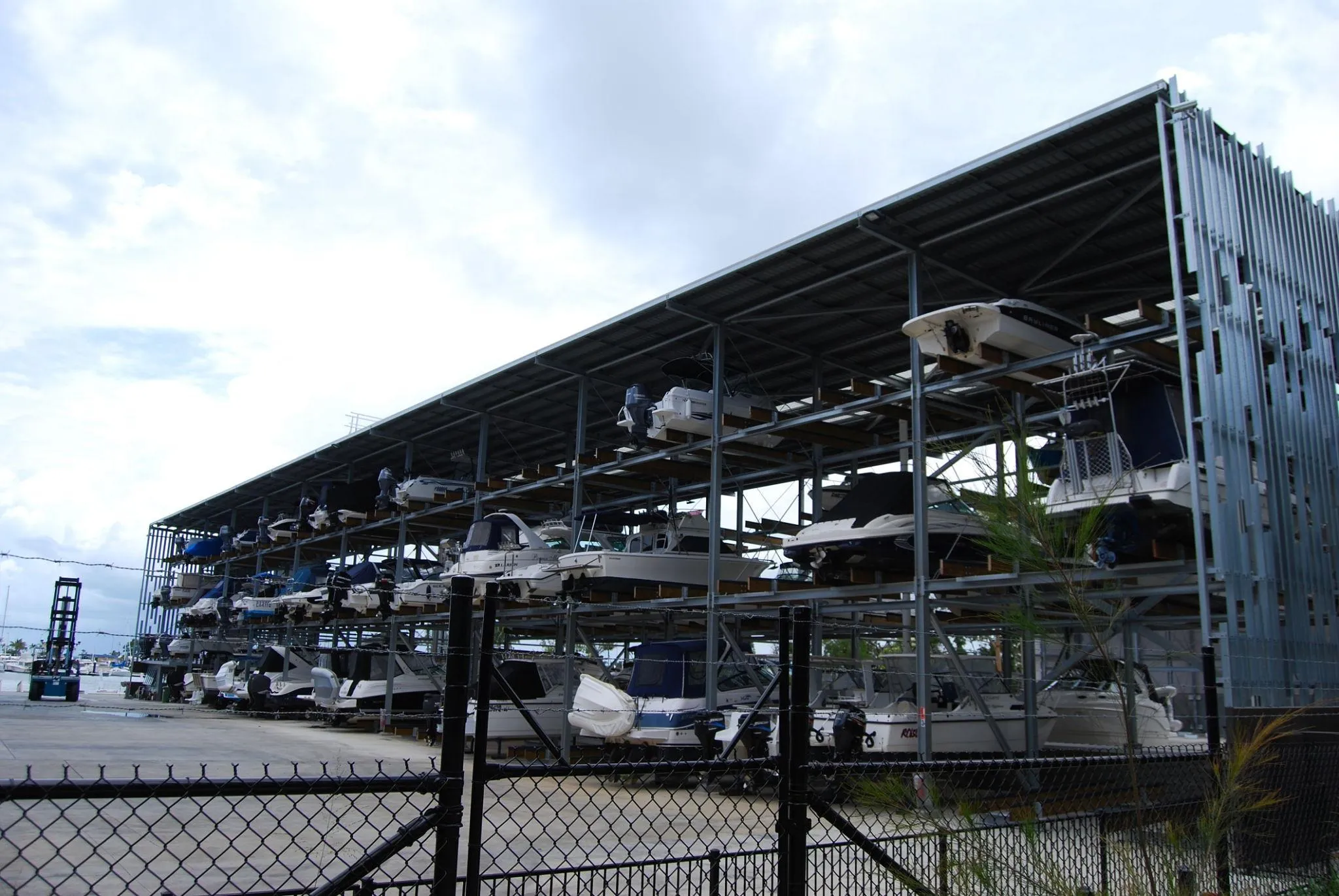
Parking matters here too. A trailer stored under a canopy takes far less UV than one in an open lot, which is one of the quieter arguments for covered storage over outdoor. If the trailer lives without the boat on it, our trailer storage guide for Naples covers that case.
Galvanized or aluminum for a saltwater trailer?
Both beat painted steel in salt water, and the choice usually comes down to budget and how you treat it. Galvanized steel is tough, cheaper and handles knocks well, but the coating can be breached and will then corrode at that point. Aluminum does not rust, is lighter, but can suffer galvanic corrosion where it meets dissimilar metals such as steel fasteners and bunk hardware.
Painted steel in saltwater is a false economy and is best avoided for a trailer that gets dunked. Whichever you have, the fasteners, brake hardware, springs and the wiring are the parts that fail first, because they are the mixed-metal, small-section components that brine attacks fastest.
What else needs checking before the season?
Brakes, lights, wiring, winch and bunks, and the safety chains. Surge brakes seize and corrode when a trailer sits, so check that the actuator moves freely and the lines are sound. Submersible LED lights still corrode at the connector rather than the lamp, so pull each connection apart, clean it and pack it with dielectric grease.
Check the bunk carpet for wear that has exposed staples, because an exposed staple will scratch a hull every time the boat loads. Check the winch strap for fraying and the safety chains and hitch for distortion. Grease the coupler and check the ball size actually matches the coupler stamp.
October is the natural time for all of it, since the boat is coming out of summer storage anyway. We cover the engine side of that in our guide to de-winterizing a boat in Florida, and the hull side in boat bottom cleaning and barnacles. Keeping the trailer serviceable also keeps the rig movable, which matters because Atlantic hurricane season runs to the end of November. Our hurricane boat storage guide covers the plan.
Where you keep the rig changes how much of this you have to do
A trailer parked in an open lot in full sun ages faster than one under a canopy, and a trailer you cannot easily get to is a trailer that does not get maintained. The practical requirements are shade, somewhere to rinse, power for a light and a charger, and room to jack a wheel safely.
At The Hideout, covered bays come in 12′ x 25′, 12′ x 40′, 12′ x 60′ and 12′ x 80′ with 30 amp electric, outdoor spaces take oversized rigs, and there is an onsite wash area plus an onsite boat mechanic, detailing and electrical work. Access is 24/7 through the mobile gate app, the site is gated with AI-powered security cameras, and the drive aisles are wide enough to turn a long rig in one movement. The facility was named Toy Storage Nation’s Facility of the Month in March 2026. Sizing help is in our RV, boat and trailer storage size guide.
Frequently asked questions
What kind of maintenance do boat trailers need?
Rinse with fresh water after every saltwater launch, inspect and repack wheel bearings at least annually, check tire pressure and sidewall condition before every trip, clean and grease light connections, and inspect brakes, bunks, winch strap and safety chains each season. Saltwater use drives the schedule far more than mileage does.
How often should a boat trailer be serviced?
For a saltwater trailer, a full service once a year plus a quick check before every trip is the sensible baseline. Bearings, brakes and lights are the annual items. Tire pressure, lights working and the coupler latched are the every-trip items.
How do I know if my boat trailer bearings are bad?
The three signs are a hub that is noticeably hotter than the others after a tow, any rocking play when you grip the tire top and bottom and rock it, and a rumbling or growling you can feel through the frame. Grease that looks milky, gritty or discolored when you pull a cap means water has already got in.
How much does boat trailer maintenance cost?
It depends on whether you do it yourself and on how many axles the trailer has. A bearing and seal kit is an inexpensive part, and the cost is mostly labor and whether brakes need attention at the same time. Get a quote for your specific trailer rather than working from an average.
Should I grease the hubs on my boat trailer, and how?
Yes, but inspect rather than only pumping grease in. Adding fresh grease on top of water-contaminated grease hides the problem instead of fixing it. The job worth doing is pulling the hub, cleaning everything, checking the races for pitting, repacking by hand and fitting new seals.
Keep the rig somewhere you can look after it
The Hideout Storage Park has covered and outdoor bays, an onsite wash area and an onsite boat mechanic at 195 Basik Dr., Naples, FL 34114. Call (239) 213-8029 or contact us for availability. We serve Naples, Marco Island and Bonita Springs, listed on our service areas page.
