

What size storage unit do I need? If you own an RV, boat, or trailer, that question comes before every other storage decision — before cost, before contract terms, before anything else. Get the size wrong and you either damage your rig squeezing it into a tight space, or you overpay every month for square footage you never use.
This storage unit size guide breaks it down by vehicle type — RVs, boats and their trailers, and utility/cargo/enclosed trailers — so you know roughly what to ask for before you ever pick up the phone. At the end, we’ll cover how The Hideout Storage Park in Naples, FL actually matches owners to the right space, including what to do when your vehicle doesn’t fit neatly into a standard size bracket.
Why “Storage Unit Size” Works Differently at a Vehicle Storage Park
Most people’s mental model of “storage unit size” comes from traditional self-storage: a 10×10 or 10×20 indoor cubicle with a roll-up door. That model breaks down fast for RVs, boats, and trailers.
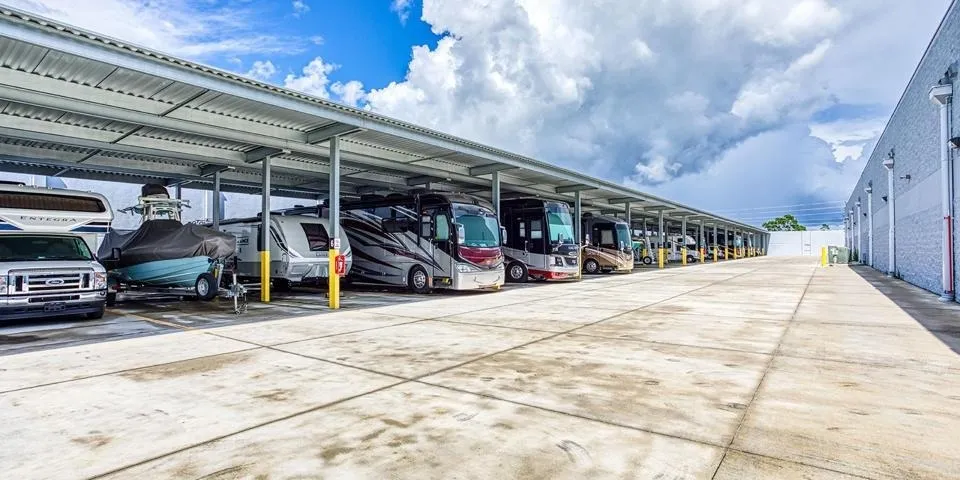
The Hideout Storage Park is built around a different logic entirely — it’s a not a traditional self-storage company but a purpose-built vehicle storage park, and this storage unit size guide reflects that. Instead of an indoor unit measured wall-to-wall, you’re renting an outdoor or covered parking space sized to your vehicle’s length and width, with a wide drive aisle attached so you can actually maneuver a 35-foot fifth wheel or a 24-foot center console without a three-point turn every time.
That changes how you should think about “size.” Two numbers matter far more than they do in traditional self-storage:
- Overall length — bumper to bumper (or hitch to transom, for a trailered boat), not just the manufacturer’s stated body length.
- Turning and backing clearance — how much drive-aisle width the lot gives you to actually get the vehicle into the space without clipping a neighbor’s rig.
Get those two right, and the rest of the sizing conversation is straightforward. The sections below walk through typical length ranges by vehicle type, so you have a realistic starting point before you call.
What Size Space Does Your RV Actually Need?
RV storage unit sizes are almost always quoted by the vehicle’s overall length, so start there. According to industry length breakdowns from RVShare and Storage.com, typical RV length ranges by class are:
| RV Type | Typical Length Range |
|---|---|
| Class B (camper van) | 17–23 ft |
| Class C motorhome | 20–33 ft |
| Travel trailer | 12–35 ft |
| Fifth wheel | 22–40 ft (plus 3–5 ft for the pin box/hitch overhang) |
| Class A motorhome | 26–45 ft |
A few practical notes that change what size space you actually need:
- What size storage unit for a travel trailer depends heavily on the model — a bumper-pull travel trailer at the small end (12–16 ft) needs a much smaller space than a triple-slide 35-footer. Always measure your specific trailer, not the “travel trailer” category average.
- Fifth wheels need extra length beyond the stated trailer body. The pin box overhangs the tow truck’s bed by 3–5 feet, and that overhang doesn’t show up in the manufacturer’s published length — but it does show up when you’re sizing a parking space.
- Slide-outs affect width, not length, but they matter for drive-aisle clearance if slides will be extended while parked. Ask whether the facility allows slide-outs to remain out in your space.
- Height matters for covered storage. If you’re considering a covered space with a canopy, confirm your RV’s roof height (including AC units and antennas) against the canopy clearance before assuming it fits.
When in doubt, measure bumper to bumper (or hitch ball to rear bumper for towables) and round up. It’s always easier to size down later than to discover mid-move-in that your rig is two feet too long for the space you reserved.
How Big a Space Do You Need for a Boat & Trailer?
Boat trailer storage size questions trip people up more than RV sizing does, for one specific reason: most owners think in terms of hull length, but storage facilities size spaces around the overall trailer length — hull plus trailer frame, hitch, and any motor or swim platform overhang.
According to America’s Boating Club and boat-trailer buying guides, a trailer typically runs 2 to 6 feet longer than the boat itself, since the frame needs to extend past the transom for proper hull support and the tongue adds length at the front. So how big of a storage unit do I need for a boat really comes down to: measure the trailered combination, not just the hull.
Rough starting points by common boat type (trailer-and-boat combined length):
- Bow riders / small runabouts (18–24 ft hull): typically 22–28 ft combined with trailer
- Center console / pontoon boats (20–28 ft hull): typically 24–32 ft combined with trailer
- Sailboats (20–40+ ft hull): highly variable — mast height and beam often matter as much as trailer length; these frequently need a larger footprint and sometimes a dedicated dry-storage arrangement
Two measurement mistakes are worth calling out specifically:
- Don’t use LOA (length overall) alone. LOA can be inflated by a swim platform or bow pulpit that doesn’t reflect what the trailer actually supports. Measure the trailered combination bow to trailer hitch.
- Account for outboard motor tilt. A tilted-up outboard can add a foot or more to the rear overhang versus the motor down.
If you’re storing seasonally around hurricane season, sizing correctly also matters for hurricane prep logistics — a space that’s already tight on length gives you less room to maneuver when you need to move quickly ahead of a storm.
Utility, Cargo & Enclosed Trailer Sizing Considerations
Enclosed trailer storage size questions come up most from owners with car haulers, landscape trailers, and equipment trailers — a category that gets less attention in most storage guides but is common at a facility built for oversized vehicles.
A few sizing considerations specific to this category:
- Car haulers and enclosed cargo trailers commonly run 16–28 ft, but always add tongue length to the enclosed box measurement — the box length alone understates what space you need.
- Landscape and equipment trailers vary widely by load-bearing deck length; a tandem-axle equipment trailer hauling a compact tractor needs meaningfully more length than a single-axle landscape trailer.
- Height clearance matters more here than for boats. Enclosed car haulers and cargo trailers are often taller than open trailers, so if you’re considering covered storage, confirm the trailer’s exact height against canopy clearance before committing.
- Multiple trailers, one owner. If you own both a toy hauler and a smaller utility trailer, ask whether a facility can accommodate both on one lease or whether you’ll need two separate spaces — this affects total footprint more than any single vehicle’s dimensions.
Outdoor vs. Covered vs. Long-Term Car Storage: How Space Requirements Differ by Tier
Sizing isn’t just about vehicle length — it’s also about which storage tier fits your vehicle and your goals. The Hideout Storage Park offers a few different tiers, and space requirements shift slightly depending on which one you’re considering:
- Outdoor storage is the most flexible tier for length and height, since there’s no canopy clearance to work around — the main constraint is drive-aisle width for maneuvering.
- Covered storage comes in four space sizes — 12’x25′, 12’x40′, 12’x60′, and 12’x80′ — running $375–$620/mo (plus tax) with 30-amp electric included. The canopy overhead means height clearance becomes a real sizing factor alongside length: always confirm your vehicle’s full height, including roof-mounted AC units, antennas, or a raised tonneau, against the canopy’s clearance before picking a size.
- Elite Storage Condos are deeded, private units with their own dimensions and no climate control — sizing here is a conversation with the team about the specific condo footprint rather than a general range.
- Long-term car storage is the one fully enclosed, air-conditioned, climate-controlled tier at The Hideout — a different product from Elite Condos or standard car storage. If your vehicle is sensitive to heat and humidity (a collector car, for example), this is the tier where “size” also means confirming an enclosed bay actually fits your vehicle’s length, width, and height with room to open doors — availability is limited, so ask early.
Because tier-by-tier availability can shift with demand, confirm current space sizes and openings directly with The Hideout before committing.
Common Sizing Mistakes That Cost Owners Money
A handful of sizing mistakes come up over and over, and both directions cost you:
Undersizing costs you in damage risk. Squeezing a vehicle into a space that’s too tight increases the odds of scraping a fender against a neighboring rig, damaging awnings or slide-outs, or struggling to open doors and compartments fully. A too-small space isn’t a savings — it’s a liability against a vehicle that’s often worth tens of thousands of dollars.
Oversizing costs you every single month. Reserving a space several feet longer than your vehicle “just in case” means paying for square footage you never use, for as long as you rent it. Over a year, the gap between a right-sized space and an oversized one adds up.
Measuring the wrong dimension. As covered above, this shows up constantly: RV owners quoting the manufacturer’s “dry length” instead of bumper-to-bumper length; boat owners quoting hull LOA instead of trailered combination length. Always measure the actual, current, real-world footprint of your vehicle as it will roll into the space — accessories, hitches, and overhangs included.
Forgetting seasonal or future vehicles. If you’re likely to upgrade rigs in the next year or two, or you store a second vehicle seasonally, it’s worth a quick conversation about flexibility now rather than resizing later — see the next section.
How The Hideout Matches You to the Right Space
Because sizing isn’t one-size-fits-all, The Hideout’s approach is built around getting it right before you move in, not after:
- Wide drive aisles and generous turning radius across the property mean the maneuvering-clearance side of sizing is handled by the lot design itself, not something you have to solve for on your own.
- Mobile gate access lets you come and go on your own schedule once you’re sized and settled in, without waiting on staff for entry.
- Staff verification of your vehicle’s actual dimensions before you commit means you’re not guessing at a size bracket over the phone — the team confirms what fits.
- Month-to-month flexibility means if your first space turns out to be a slightly wrong fit — or your next vehicle is a different size than your last — you’re not locked into a long-term agreement that doesn’t match what you actually need. (We cover the tradeoffs between month-to-month and longer-term agreements in more detail in an upcoming post on storage contract options.)
If you’re comparing tiers, our companion guide on RV storage cost in Naples, FL and the boat storage pricing guide walk through what each tier costs once you know what size you need. And if HOA restrictions are part of why you’re storing off-site in the first place, Naples HOA rules for RVs covers that angle separately.
We’re also working on a dedicated breakdown of climate-controlled vs. covered vs. outdoor storage in Florida and a piece on RV storage security features — both currently in progress and worth checking back for once published.
Frequently Asked Questions
What size storage unit do I need for my RV, boat, or trailer?
It depends on your vehicle’s overall length and, for covered storage, its height. Measure bumper-to-bumper for an RV, or the full trailered combination (not just hull length) for a boat, and round up slightly rather than down. The Hideout’s team can confirm the right fit once you share your vehicle’s actual dimensions.
What size storage unit do I need for a travel trailer?
It varies by model — bumper-pull travel trailers commonly range from 12 to 35 feet. Measure your specific trailer’s overall length, including the hitch, rather than relying on the general “travel trailer” category average, since the range is wide.
How big of a storage unit do I need for a boat?
Size the space to your trailered combination, not just your boat’s hull length. Trailers typically run 2 to 6 feet longer than the boat itself, so a boat-and-trailer combination is usually several feet longer than the hull length alone suggests.
What’s the difference between rv storage unit sizes at a traditional self-storage facility versus a vehicle storage park?
Traditional self-storage sizes indoor cubicles (like a 10×20 unit). A purpose-built vehicle storage park like The Hideout sizes outdoor or covered parking spaces to your vehicle’s length and width, with wide drive aisles built in for maneuvering — a different model designed specifically around oversized vehicles.
What size space do I need for an enclosed trailer?
Enclosed car haulers and cargo trailers commonly run 16 to 28 feet, but always add tongue length to the enclosed box measurement, since the box length alone typically understates the space you’ll need. Height also matters more here than for open trailers if you’re considering covered storage.
Not Sure What Size You Need? Ask The Hideout Directly
The fastest way to get an accurate answer is to skip the guesswork and talk to the team. The Hideout Storage Park in Naples, FL matches RV, boat, and trailer owners to the right space based on your vehicle’s actual dimensions — not a generic size bracket.
Call (239) 213-8029 or contact The Hideout online with your vehicle’s length, width, and height, and the team will confirm what fits and what tier makes sense. Visit the full storage options page to see everything available.
Serving Naples, Marco Island, Bonita Springs, and the rest of Collier County.
