

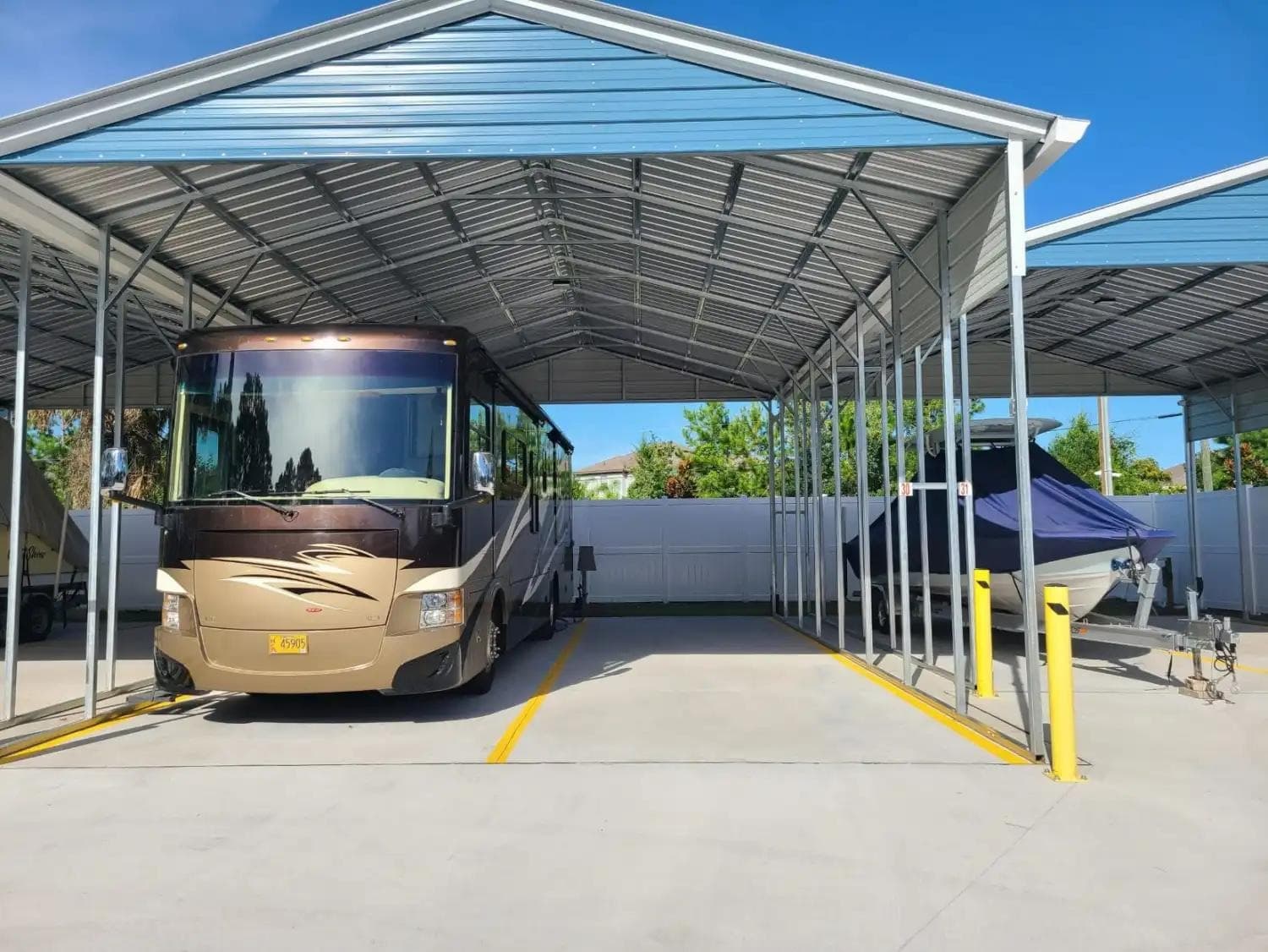
The fastest way to destroy an RV generator is to never run it. Fuel varnishes in the carburetor, seals dry out and the battery it needs to start goes flat, so a unit left untouched through a Florida summer often will not start when you need it. The fix is a monthly run under load, an oil change on schedule, and somewhere you can actually do it safely, like a powered covered bay.
Generators are the most neglected system on a stored RV, because nothing reminds you about them. The roof leaks and you notice. The tires go down and you notice. The generator simply sits, quietly going bad, and announces itself the first time you need power and get nothing.
How often should an RV generator be exercised?
Run it about once a month for roughly two hours under a real load, meaning with the air conditioner or another substantial draw switched on rather than idling with nothing connected. A monthly loaded run keeps fuel moving through the carburetor, keeps seals wet, charges the starting battery and burns off moisture inside the engine.
Running it with no load is much less useful and can be actively bad. An unloaded engine runs cooler than it should, does not fully burn its fuel, and leaves carbon and unburnt residue behind. If you only do one thing, make the monthly run a loaded one.
This is one of the places a storage facility either helps or gets in the way. You need to be able to reach the RV, run the unit for two hours without annoying anybody, and have power available for everything else you are doing. Our covered bays include 30 amp electric and access is 24/7 through a mobile gate app, which makes a monthly visit realistic rather than aspirational.
How often should I change the oil in my RV generator?
Generator oil is changed on engine hours rather than calendar months, and the interval is set by the manufacturer for your specific unit, so the hour meter and the manual are the only honest answer. Onan and other common units publish their own schedules, and the first service after break-in is usually much earlier than the ones that follow.
What is universal is that generator oil works harder than you would expect. These are small air-cooled engines running at constant speed under load in high ambient temperatures, which is about the least forgiving duty cycle there is. In Southwest Florida, where summer heat is relentless, that matters more than it does further north.
Also change the oil before a long layup rather than after. Used oil is acidic, and leaving it sitting in a hot engine for five months does damage that a fresh fill would not. The same logic applies to the rest of the rig, which we cover in the complete Southwest Florida RV storage checklist.
What actually fails on a generator that sat all summer?
Fuel first, then the battery, then seals and the exhaust. Fuel left in a carburetor evaporates and leaves a varnish that blocks small passages, which is the single most common reason a stored generator cranks but will not run. After that it is a flat starting battery, dried-out gaskets and corrosion in the exhaust and muffler.
The fuel problem is largely preventable. Either run the unit regularly so fresh fuel keeps passing through, or add a stabilizer and run the engine long enough to get treated fuel all the way into the carburetor before the RV goes to sleep. Treating the tank and then not running the engine leaves untreated fuel sitting exactly where the damage happens.
Rodents are the other one nobody plans for. A generator compartment is sheltered, and wiring looms and air filters are attractive nesting material. Check the compartment whenever you visit, not just the unit.
Carbon monoxide: the part that is not optional
A generator produces carbon monoxide, which is colorless and odorless, so where you run it matters more than any maintenance item in this post. Ready.gov advises that generators and fuel should always be used outdoors and at least 20 feet away from windows, doors and attached garages, and that carbon monoxide detectors should be installed and working.
For an RV in a storage bay, read that as: run it outside, with the exhaust pointing away from your own rig and your neighbor’s, never inside an enclosed building, and never with anyone sleeping in the RV while it runs unattended. Check that the RV’s own carbon monoxide detector works and is in date, because those detectors expire and most people never check.
Exhaust direction is the detail people get wrong in a storage park specifically. Bays sit close together, and an exhaust aimed at the rig next door is somebody else’s problem that you created.
Where it sits changes how well it survives
A generator in an RV parked in open sun through a Florida summer lives a harder life than one under cover, because heat accelerates fuel degradation and rubber aging. Shade is not cosmetic here. Power at the bay matters too, because a battery maintainer keeps the starting battery healthy, and a flat starting battery is the thing that turns a two hour exercise run into a jump start and an afternoon.
At The Hideout, covered bays run 12′ x 25′, 12′ x 40′, 12′ x 60′ and 12′ x 80′ with 30 amp electric, and outdoor spaces take the oversized rigs. Outdoor storage runs $175 to $230 per month and covered runs $375 to $620 per month plus tax, with no contract required on outdoor spaces. There is an onsite wash area, electrical work available, 24/7 access through the mobile gate app, gated entry, AI-powered security cameras and wide drive aisles. The facility was named Toy Storage Nation’s Facility of the Month in March 2026.
If you are comparing products, our RV storage cost guide and the comparison of climate-controlled, covered and outdoor storage both cover it. For towables specifically, see travel trailer and fifth wheel storage.
A monthly visit that covers everything
Run the generator for two hours under load. While it runs, walk the roof seams and look for cracking, check the tires and inflate them, look in the generator compartment for nests, check the battery maintainer is doing its job, and open the roof vents for half an hour to move the air through. Dump and flush the tanks if anything is sitting in them, which our guide to RV dump stations near Naples and Collier County covers, and note The Hideout has one onsite.
That is one trip a month and it prevents most of what goes wrong with a stored RV in this climate.
Frequently asked questions
How often should an RV generator be serviced?
Servicing is set by engine hours and by your unit’s manufacturer schedule, so check the hour meter against the manual rather than using a calendar. Separately from servicing, run the generator about monthly for two hours under load, which is the maintenance item that matters most for a generator that mostly sits.
How much does it cost to service an RV generator?
It depends on the unit, the hours on it and whether anything beyond oil, filters and plugs is needed. Carburetor work after a long layup costs considerably more than routine servicing, which is the practical argument for the monthly run. Get a quote against your hour meter rather than working from an average.
Is it okay to run an RV generator all night?
Not unattended, and not where exhaust can reach anyone sleeping. Carbon monoxide is colorless and odorless, so the risk is invisible. If you run one overnight, it must be well clear of windows, doors and other rigs, with a working carbon monoxide detector inside the RV. In a storage bay, overnight running is not appropriate.
Can I run my RV generator while it is in a storage bay?
Usually yes in an open outdoor bay, with the exhaust pointed away from neighboring rigs and away from any building, and never inside an enclosed structure. Check the facility’s own rules first, because sites differ, and be considerate about timing since a two hour run is audible.
What happens if an RV generator sits unused for a year?
Expect varnished fuel in the carburetor, a flat or dead starting battery, dried seals and possibly rodent damage to wiring. Most units in that state need carburetor cleaning at minimum. Do not simply crank it repeatedly, because that drains the battery and can wash fuel into the oil.
Somewhere with power and room to run it
The Hideout Storage Park has covered bays with 30 amp electric, outdoor spaces for oversized rigs and 24/7 access at 195 Basik Dr., Naples, FL 34114. Call (239) 213-8029 or contact us. We serve Naples, Marco Island and Bonita Springs.
