

TL;DR: Dry stack boat storage keeps your boat in a rack inside a waterfront building, and a forklift launches it when you call ahead. Land storage keeps the boat on its own trailer at an inland facility like The Hideout Storage Park, where you hitch up and tow it wherever you want. Dry stack wins on launch convenience at one ramp. Land storage wins on cost, boat size limits, trailer access and storm exposure.
If you keep a boat in Naples or on Marco Island, you have probably been quoted both options and told they are much the same thing. They are not. Dry boat storage is a category, and dry stack is only one product inside it. Picking the wrong one usually shows up later as a size limit you cannot get around, a launch window you cannot make, or a hurricane season you spend worrying about.
Here is the honest comparison, including the parts where dry stack is the better answer.
How does dry stack boat storage actually work?
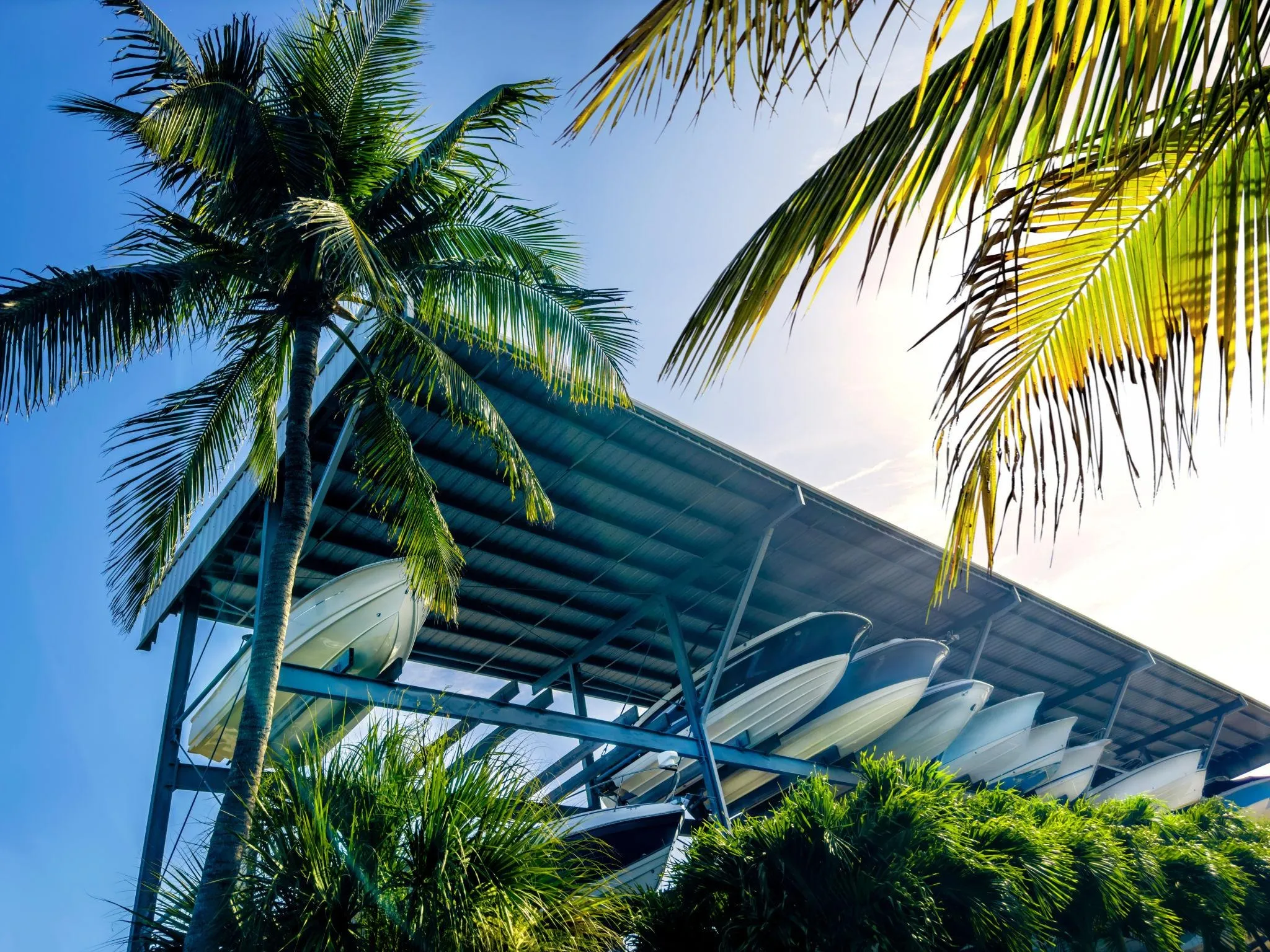
Dry stack boat storage is a multi-level steel rack, usually inside a marina building, where boats sit in cradles stacked three to five high. You call the marina ahead of your trip, a forklift operator pulls your boat down, and it is in the water by the time you arrive. When you come back, you hand it over and leave.
That is the whole appeal, and it is a real one. No trailer, no ramp queue, no backing down a launch. Some facilities include a rinse on the way back in. You will hear the same product called boat rack storage or dry dock boat storage depending on who is selling it, but the mechanism is identical: a forklift, a rack and a fixed launch point.
The trade is that you are tied to that marina’s water. The boat launches where the building is, during the hours the operator works, and only if the forklift can lift it.
What are the size and weight limits on a dry stack rack?
Dry stack racks are limited by what the forklift can safely lift and what the bay height allows, so each facility publishes a maximum length, beam and weight. Above those numbers the rack is simply not an option, and no amount of negotiating changes it.
This is where a lot of Naples boaters get caught. Center consoles and bay boats in the low twenties fit almost anywhere. A larger express with a tower, a triple outboard set-up, or a pontoon with a hardtop starts running into bay height and lift capacity fast. Sailboats with fixed keels are out entirely.
Land storage has no forklift, so the limit is the bay. At The Hideout, covered storage bays run 12′ x 25′, 12′ x 40′, 12′ x 60′ and 12′ x 80′, and outdoor spaces take oversized rigs that no rack would accept. If you are unsure which size your boat and trailer actually need, our RV, boat and trailer storage size guide walks through measuring it properly.
How much does dry stack boat storage cost?
Dry stack pricing is usually quoted per foot per month and sits at the premium end of boat storage, because you are paying for a waterfront building, a forklift and the staff to run it. Land storage is quoted per bay and is generally cheaper for the same boat, since there is no launch service bundled into the price.
At The Hideout, outdoor storage runs $175 to $230 per month and covered storage runs $375 to $620 per month plus tax, with 30 amp electric and a canopy on the covered bays. No contract is required on outdoor spaces. For a wider picture of what boat storage costs around here, including marina wet slips, see our Naples boat storage pricing guide and our breakdown of where to store your boat near Naples and Marco Island.
The number that does not appear on either quote is what you save by not paying for a service you will not use. If you tow to Everglades City, Goodland and Marco on different weekends, a fixed launch point at one marina is not worth a premium.
Which one is safer in a hurricane?
Land storage at an inland facility is the safer choice in a named storm, because dry stack buildings sit on the waterfront by design and that is exactly where surge goes. The National Hurricane Center describes storm surge as an abnormal water level rise generated by a storm over and above the predicted astronomical tide, and notes it is currently the leading cause of fatalities from hurricanes.
A rack three levels up is above a lot of water, but the building, the forklift, the power and the access road are all at ground level. If the facility cannot operate, your boat stays where it is until it can.
The Hideout sits inland at 195 Basik Dr. in Naples, and your boat stays on its own trailer, which means it can be moved before a storm rather than recovered after one. We covered the full pre-season routine in our guide to hurricane boat storage in Naples and Marco Island.
Where can I find dry boat storage near me in Naples?
Naples and Marco Island have both options within a short drive: dry stack racks at several waterfront marinas, and inland land storage parks that take trailered boats. The right search depends on the boat, not the map. Look for rack storage if the boat fits and you launch at one ramp, and land storage if it does not or you do not.
If you want to see the inland option before deciding, our service areas page covers Naples, Marco Island and Bonita Springs, and the gallery shows the bays as they actually are.
The short version
Choose dry stack if your boat is under the rack’s published limits, you launch from the same marina almost every time, and you would rather pay a premium than own and tow a trailer.
Choose land storage if your boat is large, you tow to different ramps, you want the trailer with the boat, you want the lower monthly cost, or you want the rig sitting inland when a storm is named. At The Hideout you also get 24/7 access through the mobile gate app, gated entry with AI-powered security cameras, wide drive aisles, an onsite wash area, an onsite boat mechanic and detailing. The facility was named Toy Storage Nation’s Facility of the Month in March 2026.
Frequently asked questions
How much does dry storage for a boat cost?
Dry storage covers two different products at different prices. Dry stack racks at a marina are typically quoted per foot per month and sit at the premium end. Inland land storage is quoted per bay, and at The Hideout runs $175 to $230 per month outdoors or $375 to $620 plus tax under cover.
Is dry stack boat storage better than a wet slip?
For most trailerable boats, yes. A boat kept out of the water does not grow marine life on the hull, does not sit in salt water between trips, and is not exposed to floating debris. A wet slip only wins when the boat is too large for a rack or you use it several times a week.
Can I get to my boat whenever I want in dry stack storage?
Usually not. A forklift and an operator have to be available, so most marinas ask for advance notice and work set hours. Land storage on a trailer is the opposite: at The Hideout you have 24/7 access through the mobile gate app and can hook up and leave whenever you like.
What is dry dock boat storage?
Dry dock is used loosely in marketing to mean any out-of-water storage, so it may describe a rack, a covered bay or an open lot. Ask which one is actually being quoted, and ask for the size limits in writing before you sign.
Does dry stack boat storage near me take pontoons?
Sometimes, but pontoons are often the first boats a rack turns down, because of beam and the way the cradle has to support the hull. Pontoons with a hardtop or a tower are harder again. Land storage on the trailer has no such restriction.
Ready to store your boat inland?
Call The Hideout Storage Park at (239) 213-8029 or contact us and we will tell you which bay size fits your rig and what it costs. We are at 195 Basik Dr., Naples, FL 34114, serving Naples, Marco Island, Bonita Springs and the rest of Collier County.
