

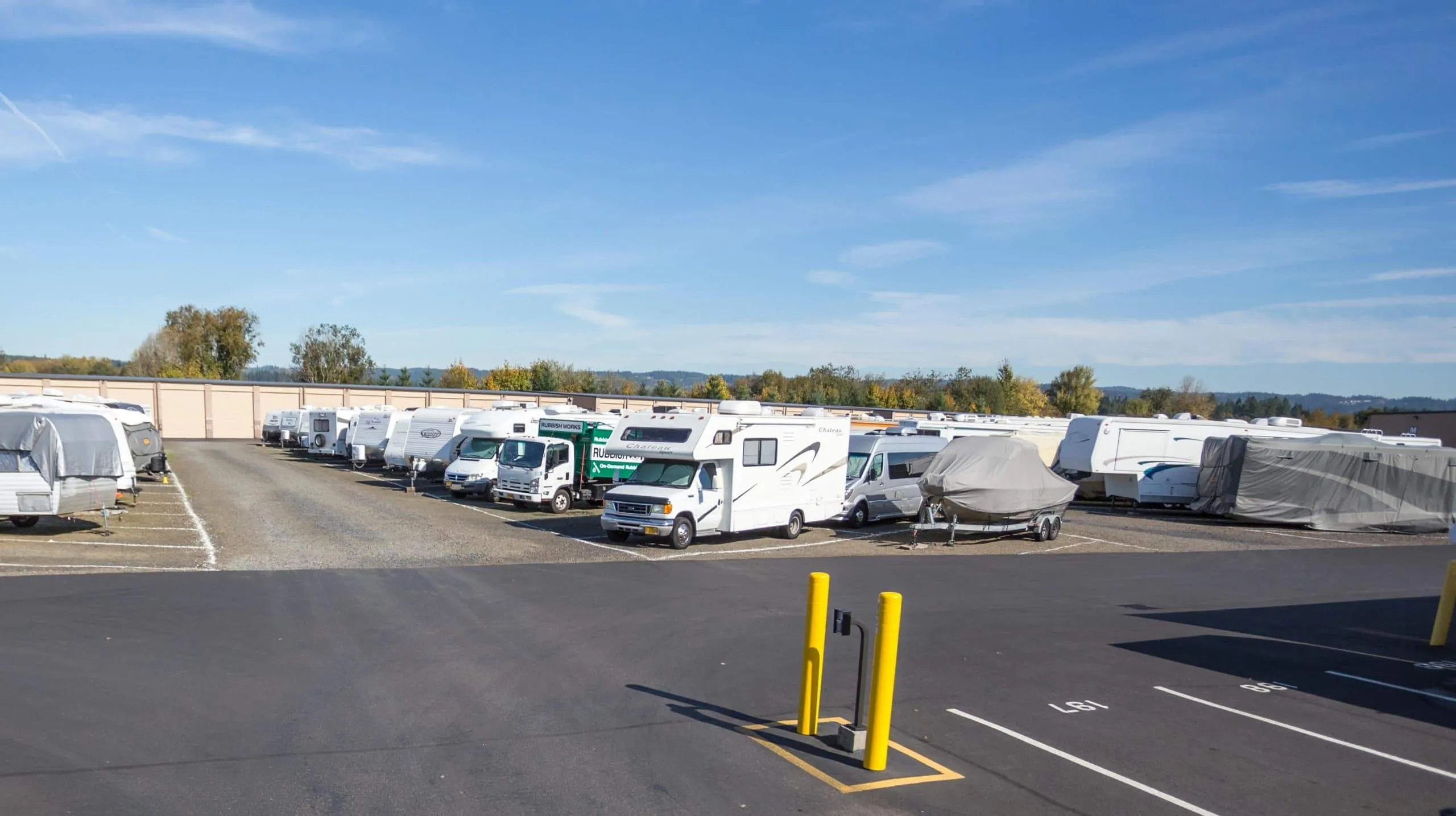
Backing a trailer comes down to one rule: put your hand at the bottom of the steering wheel and move it the way you want the back of the trailer to go. Everything else is patience, small inputs and getting out to look. This guide covers the basic method, then the part nobody teaches, which is reversing into a storage bay with rigs parked tight on both sides.
Most people learn this badly, in public, with somebody waiting. It is a learnable skill rather than a talent, and the learning goes much faster once you stop fighting the mirrors and accept that the trailer always turns opposite to the tow vehicle.
What is the trick to backing up a trailer?
Hold the bottom of the steering wheel and steer in the direction you want the trailer to go. If you want the trailer to go right, move your hand right. That single reframe removes the mental flip that makes backing up a trailer feel impossible, and it works the same for a boat trailer, a utility trailer or a fifth wheel.
The reason it works is that from the bottom of the wheel, your hand moves the same way the trailer’s rear end does. From the top of the wheel you have to invert everything in your head while also watching two mirrors and a moving pivot point, which is one job too many.
The second half of the trick is input size. Small corrections, early. A trailer responds slowly and then suddenly, so a big steering input you hold for two seconds becomes a jackknife you cannot see coming. Turn a little, pause, watch what the trailer does, then correct.
How do you reverse a trailer for beginners?
Start in an empty lot with cones or nothing at all, set the mirrors so you can see the full length of both sides of the trailer, and practice straight-line reversing before you attempt any angle. Straight back for thirty feet, correcting constantly, teaches the feel faster than any amount of reading.
Then practice the setup rather than the maneuver. Most failed attempts are failed approaches: people start too close, at the wrong angle, with the trailer already pointing somewhere unhelpful. Pull forward past the bay, swing wide, and give yourself an approach that starts the trailer already angled toward the opening.
Get out and look. Experienced drivers do this more than beginners, not less. There is no prize for staying in the seat, and one walk round tells you more than thirty seconds of mirror guessing. Pull forward and reset whenever the angle goes wrong. Resetting is the technique, not a failure of it.
What makes a storage bay harder than a driveway?
Clearance on both sides and no room to swing. A driveway usually has an open approach and forgiving edges. A storage bay has a neighbor’s rig a few feet away on each side, a fixed width, and often a canopy post you cannot see from the driver’s seat once you are halfway in.
Three things make it manageable. First, use the whole aisle: a wide drive aisle exists so you can set your angle before you start reversing, and a facility with narrow lanes is genuinely harder to use regardless of your skill. Second, pick a reference point on the ground, a crack or a mark, and aim the trailer wheel at it rather than eyeballing the whole rig. Third, use a spotter when one is available, with agreed hand signals and one person talking.
The Hideout was built with wide drive aisles and turning radius in mind, which is a decision a facility either made when it was laid out or cannot retrofit later. Our covered bays run 12′ x 25′, 12′ x 40′, 12′ x 60′ and 12′ x 80′, and outdoor spaces take the oversized rigs. If you are not sure which bay your rig needs, the RV, boat and trailer storage size guide covers measuring it properly.
Does a longer trailer back up more easily?
Yes, and this surprises people. A long travel trailer or a fifth wheel reacts slowly and gives you time to correct. A short utility trailer or a jet ski trailer pivots fast and will jackknife while you are still deciding what to do, which is why a small trailer often feels harder than a big one.
The practical consequence is that technique matters most on the small stuff. With a short trailer, make your corrections tiny and expect to be working the wheel constantly. With a long trailer, set the angle and be patient, because an input you make now shows up several feet later.
Fifth wheels sit somewhere else again. They pivot over the truck bed rather than behind the bumper, so they follow more predictably but need more room above and more attention to the front corners of the trailer as it swings. Our guide to travel trailer and fifth wheel storage covers the sizing side of that.
When is the best time to practice?
Early morning on a weekday, at the facility you actually use, when the aisles are empty and nobody is waiting. Practicing in the real bay with no audience is worth more than an hour in a car park, because the bay has the exact constraints you will face every time.
This is one of the quieter arguments for a facility with genuine around-the-clock access. The Hideout runs 24/7 entry through a mobile gate app, so you can turn up at six on a Tuesday and take twenty minutes over it. Gated entry and AI-powered security cameras cover the site, and the facility was named Toy Storage Nation’s Facility of the Month in March 2026.
If you are towing in and out regularly, the other two things worth keeping on top of are the running gear and the towing setup. We cover those in boat trailer maintenance in saltwater country and in our guide to trailer sway and how to stop it.
A short practice routine
Fifteen minutes, three drills, repeated until boring. Straight-line reverse for thirty feet, correcting to stay straight. Then a shallow angle into an open bay from the far side of the aisle. Then the same bay from the near side, which is the harder approach and the one you will need when the aisle is busy.
Between drills, get out and look at where the trailer actually ended up versus where you thought it was. That gap is the whole skill, and it closes quickly.
Frequently asked questions
What is the Z method for backing a trailer?
It is a setup technique: pull forward past the bay, swing out so the rig forms a shallow Z shape with the trailer already angled toward the opening, then reverse. It works because it does most of the turning while you are moving forward, where steering is intuitive, and leaves less to do in reverse.
How do I back up a trailer into a 90 degree spot?
Approach from the far side of the aisle so you have the widest possible arc, pull past the bay, then reverse while steering toward the opening from the bottom of the wheel. Expect to pull forward and reset at least once. A 90 degree entry from close range is the hardest version and is mostly about the approach, not the reverse.
Which mirror should I watch when reversing a trailer?
Watch the mirror on the side the trailer is turning toward, because that is the side that will run out of room first. Glance at the other mirror to check the opposite corner is not swinging into something. If the trailer disappears from both mirrors, stop immediately, because that means it has jackknifed.
Should I use a spotter when backing into a storage bay?
Yes when one is available, with agreed hand signals and only one person giving them. A spotter sees the corners and the canopy posts you cannot. If you are alone, get out and look as often as you need to, which for a tight bay may be every few feet.
Is it harder to back up a boat trailer than a travel trailer?
Usually yes, because boat trailers are shorter and pivot faster, and because the boat often blocks your view through the rear window. The method is identical, but the corrections need to be smaller and more frequent, and getting out to look matters more.
Somewhere to practice, around the clock
The Hideout Storage Park has wide drive aisles, covered and outdoor bays and 24/7 access through the mobile gate app. Call (239) 213-8029 or contact us for availability. We are at 195 Basik Dr., Naples, FL 34114, serving Naples, Marco Island and Bonita Springs. All products are on the storage options page.
